
2-Year Treasury Yield Holds Steady at 3.56% — But the Pause Itself Tells a Story
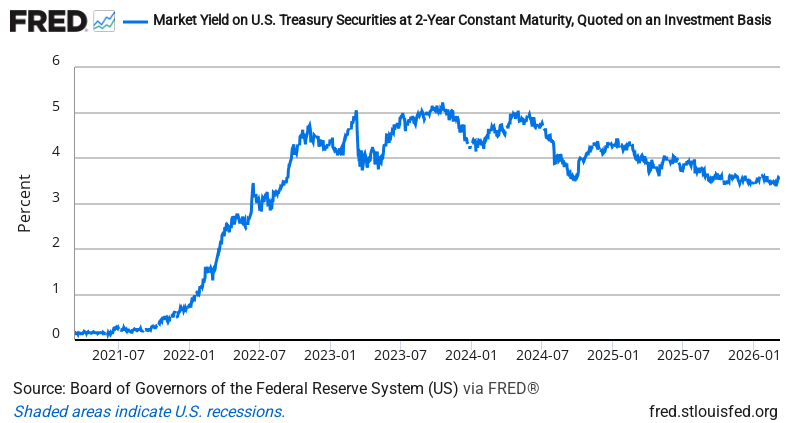
The 2-year Treasury yield sat unchanged at 3.56% on Friday, marking the second straight session without movement after a steady climb from 3.47% earlier in the week. But in a market where every basis point usually matters, sometimes standing still is the most interesting move of all.
This pause comes after bond traders spent the week digesting a puzzle: an economy showing expanding profit margins and AI-driven productivity gains alongside elevated market volatility (VIX at 23.47) and defensive sector rotation. The 2-year yield — which tracks Fed expectations more than any other rate — is essentially saying the central bank has room to stay patient while the economy sorts itself out.
Here’s what makes this particularly telling. The recent climb from 3.47% to 3.56% happened as corporate earnings showed profits rising 9.2% annualized in Q4, with margins at historic highs and still expanding. That’s the kind of data that typically pushes growth expectations higher and bond yields with them. Yet yields have plateaued, suggesting the market sees the Fed threading the needle between supporting growth and managing inflation expectations.
The historical parallel worth watching is the mid-1990s, when similar productivity cycles gave the Fed flexibility to normalize rates gradually without crushing expansion. Back then, 2-year yields moved in fits and starts rather than straight lines, pausing to let economic data catch up to market positioning.
Historically, investors have used periods like this — when short-term rates stabilize after a move — to reassess whether the economy is accelerating or cooling. The current setup, with strong corporate profits but elevated volatility, suggests professional managers are asking: is this pause before another leg higher, or have we found equilibrium?
Bottom Line: When the 2-year yield stops moving, it’s usually because bond traders are waiting for clearer signals about where the economy is heading next. In a productivity-driven expansion, that patience might be exactly what keeps the cycle running.
Source: Federal Reserve Economic Data (FRED)
ON1010.com provides economic education for investors. Nothing here is investment advice. Always consult a qualified financial advisor before making investment decisions.
Free Research
The economy moves fast. We make sure you move faster.
Economic data, policy shifts, and market signals — delivered to your inbox.
Subscribe Free