
Fed Holds Steady at 3.5%, But the Real Story Is What’s Not Happening
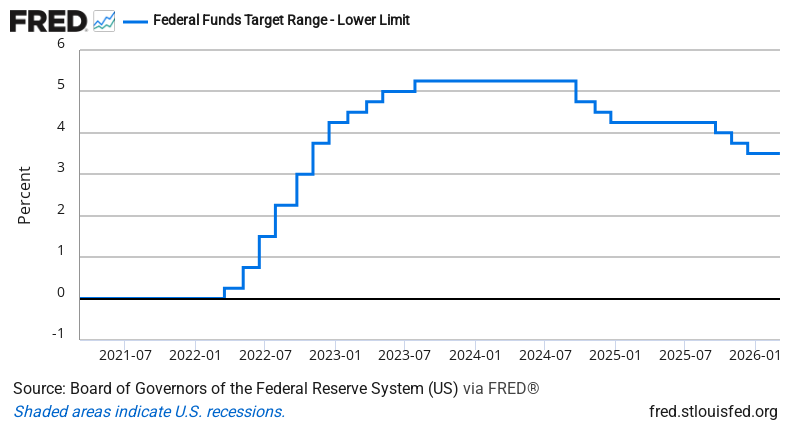
The Fed’s funds rate target held at 3.5% through early March, marking another week of policy stability. But here’s what’s interesting: markets are pricing in cuts that aren’t coming, and the disconnect is getting wider.
We’re now in month eight of the Fed holding rates in the 3.25% to 3.50% range, the longest pause since the pre-2022 hiking cycle. That’s not typical Fed behavior when the economy is supposedly headed for trouble. Central banks don’t sit still when recession risks are rising — they either cut aggressively or keep hiking to fight inflation.
The current stance suggests the Fed sees something markets might be missing. Corporate profit margins hit historic highs in Q4 and are still expanding, with profits up 9.2% annualized. When companies are making money hand over fist, they don’t need monetary stimulus to keep investing and hiring. The productivity cycle driven by AI investment appears to have years left to run, meaning the economy can grow faster without triggering inflation.
Meanwhile, defensive sectors are outperforming by 6.5 percentage points over the past month, with utilities leading the charge. That’s classic recession-fear positioning. But if recession were truly imminent, the Fed would be cutting rates already, not sitting at a restrictive 3.5%.
The historical pattern is clear: when the Fed holds rates steady for extended periods, it’s usually because they’ve achieved their target conditions. In this case, that means core inflation back near 2% and growth running at a sustainable pace. Professional managers in environments like this typically focus on the lag between monetary policy and economic effects — what the Fed does today shows up in the economy six to twelve months later.
Bottom Line: The Fed’s steady hand at 3.5% suggests they see a resilient economy that doesn’t need stimulus — even as markets position for weakness that may never materialize.
Source: Federal Reserve Economic Data (FRED)
ON1010.com provides economic education for investors. Nothing here is investment advice. Always consult a qualified financial advisor before making investment decisions.
Free Research
The economy moves fast. We make sure you move faster.
Economic data, policy shifts, and market signals — delivered to your inbox.
Subscribe Free