
Bond Market Sees Something the Fed Doesn’t Want to Admit
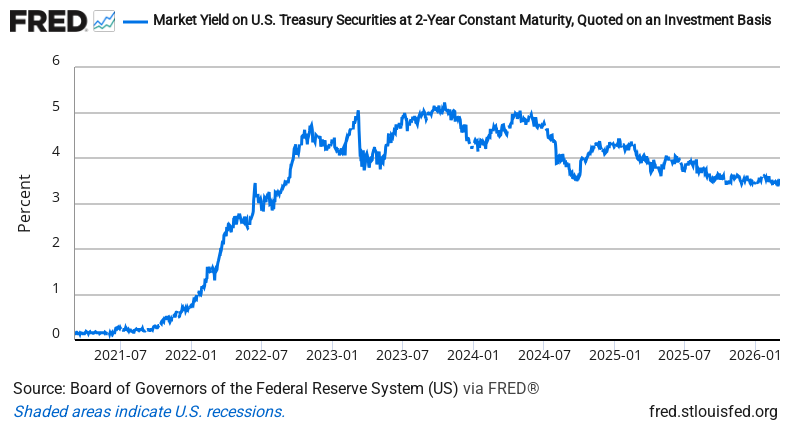
The 2-year Treasury yield jumped to 3.54% Tuesday, up from 3.51% the day before — a small move that’s part of a much bigger story. Over the past week, the yield has climbed from 3.38% to current levels, suggesting bond traders are pricing in a reality the Federal Reserve may not be ready to acknowledge.
The 2-year yield is the market’s best guess about where Fed rates will be in the near term. When it rises this consistently, it means investors are either expecting more rate hikes or fewer rate cuts than previously anticipated. Given the Fed’s recent dovish signals, this divergence is telling. Bond traders are essentially saying: “We don’t believe you can cut rates as much as you think.”
This matters because the 2-year yield often leads Fed policy, not the other way around. During the 2022 hiking cycle, the 2-year yield consistently traded ahead of where the Fed funds rate eventually landed. If history repeats, the current climb suggests either economic data will force the Fed’s hand toward higher rates, or that underlying inflation pressures remain stickier than policymakers expect.
For portfolios, this type of environment historically puts pressure on duration risk — the longer the maturity, the more sensitive bonds are to rate changes. Many professional investors consider shorter-duration bonds and floating-rate securities when the yield curve is repricing higher. Growth stocks, particularly those trading at high valuations, also tend to face headwinds when the risk-free rate climbs.
Bottom Line: When bond traders consistently bet against Fed dovishness, they’re usually onto something. The question isn’t whether rates stay higher — it’s whether the Fed will follow the market’s lead or fight it.
Source: Federal Reserve Economic Data (FRED)
ON1010.com provides economic education for investors. Nothing here is investment advice. Always consult a qualified financial advisor before making investment decisions.
Free Research
The economy moves fast. We make sure you move faster.
Economic data, policy shifts, and market signals — delivered to your inbox.
Subscribe Free