
Initial Claims Drop to 202K: The Job Market’s Quiet Confidence
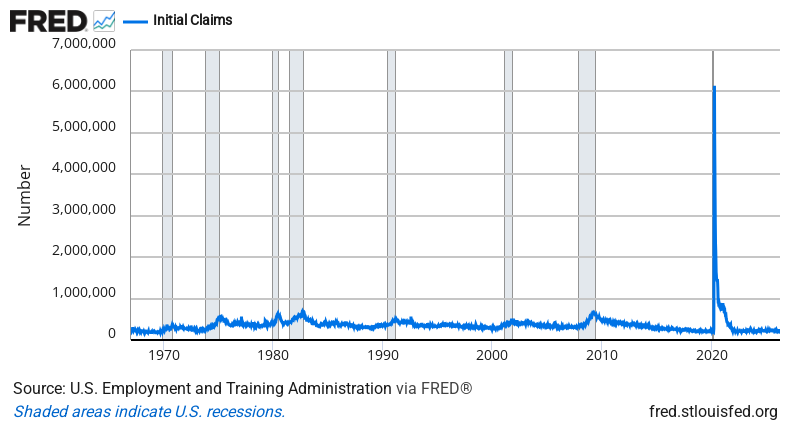
Initial jobless claims fell to 202,000 last week, down 9,000 from the prior week and marking the lowest reading in nearly a month. But here’s what’s more interesting than the drop itself: claims have been remarkably stable, bouncing between 202K and 214K over the past six weeks without any dramatic swings.
This stability tells a story about where we are economically. When claims hover in a tight range like this, it suggests businesses aren’t panicking about demand — they’re not doing mass layoffs — but they’re also not so confident they’re hoarding workers they don’t need. It’s the labor market equivalent of cruising at a steady speed: not accelerating, not braking hard, just maintaining momentum. Claims below 220K historically signal a healthy job market, and we’ve been comfortably under that threshold.
The steady pattern also suggests companies have right-sized their workforces after the post-COVID hiring spree. Remember, profit margins are a leading indicator, and when businesses feel like they have the right number of workers for current demand, it often means they’re optimizing for profitability rather than growth. That’s not necessarily bad — it can mean more sustainable hiring ahead if demand picks up.
For investors, this type of labor market stability has historically been supportive of corporate earnings and equity markets. When layoffs aren’t spiking, consumer spending tends to hold up, which feeds back into business revenue. Many professional investors view stable claims data as confirmation that any economic slowdown is managed rather than chaotic.
Bottom Line: A job market that’s not falling apart but isn’t booming either — sometimes the most bullish scenario is just boring stability.
Source: Federal Reserve Economic Data (FRED)
ON1010.com provides economic education for investors. Nothing here is investment advice. Always consult a qualified financial advisor before making investment decisions.
Free Research
The economy moves fast. We make sure you move faster.
Economic data, policy shifts, and market signals — delivered to your inbox.
Subscribe Free