
Treasury Curve Holds Steady as Oil Crisis Reshapes Fed Calculus
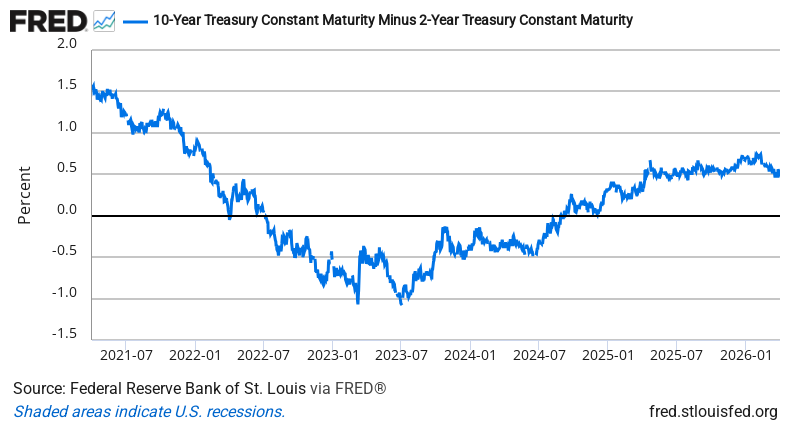
The 10-year minus 2-year Treasury spread stayed flat at 0.52% yesterday, holding near its recent range despite the ongoing energy crisis. While the curve remains positively sloped — suggesting no immediate recession signal — the stability masks a more complex story about how markets are pricing Fed policy in an environment where oil has spiked from $66 to $95 since the Strait of Hormuz closure.
Here’s what’s interesting: historically, energy shocks this severe would steepen the curve as markets price in aggressive Fed tightening. Instead, we’re seeing relative stability around 0.50%. That suggests traders aren’t expecting the Fed to chase energy-driven inflation with rate hikes — but they’re also not betting on the cuts that were priced in before February. The curve is essentially stuck in neutral, reflecting a Fed that’s paused rather than pivoting in either direction.
This makes sense given the unusual nature of this shock. The U.S. is a net energy exporter, so higher oil prices create cross-currents: inflation pressure from consumer energy costs, but also economic support from energy sector profits. The curve is telling us markets see this as more likely to cause asset price moderation than recession — consistent with how energy exporters typically weather oil spikes.
Many professional investors use curve positioning to gauge recession risk and Fed policy expectations. In this environment, the flat-ish curve suggests focusing on sectors that can pass through energy costs (technology, some industrials) while avoiding energy-intensive plays. Historically, this type of “stagflationary lite” setup has led investors to look at real assets and companies with pricing power.
Bottom Line: A stable yield curve during an energy crisis signals markets expect Fed patience, not panic. The bigger question is whether this calm holds if oil stays elevated through summer.
Source: Federal Reserve Economic Data (FRED)
ON1010.com provides economic education for investors. Nothing here is investment advice. Always consult a qualified financial advisor before making investment decisions.
Free Research
The economy moves fast. We make sure you move faster.
Economic data, policy shifts, and market signals — delivered to your inbox.
Subscribe Free