
2-Year Treasury Yields Hit Stall Speed as Energy Crisis Muddles Fed Path
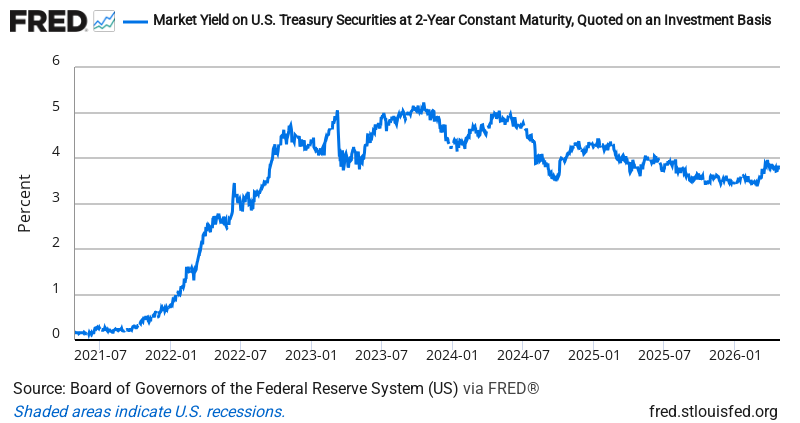
The 2-year Treasury yield held dead flat at 3.78% through Friday, capping a week of indecision that tells the story of a bond market stuck between conflicting signals. After bouncing around between 3.72% and 3.83% over the past week, the yield that best reflects Fed expectations has essentially gone sideways — unusual for a market that typically moves with conviction.
This stall comes at a critical moment. The Strait of Hormuz closure has pushed oil from $66 to $95, creating an inflation shock that should theoretically push short-term yields higher as rate cut bets evaporate. But yields aren’t spiking — they’re grinding sideways in a narrow range. That suggests bond traders are wrestling with two competing forces: energy-driven inflation that keeps the Fed on hold, versus recession fears from the oil shock that could eventually force cuts anyway. When the 2-year can’t pick a direction despite a 44% oil spike, it’s telling you the market can’t decide which scenario wins.
The bigger picture here is that the Fed’s path has become genuinely uncertain for the first time in months. Pre-energy crisis, markets were pricing a clear trajectory toward rate cuts as inflation cooled toward 2%. Now, with monthly CPI potentially printing with a 1-handle and the Fed explicitly pausing easing plans, the 2-year is reflecting genuine confusion about where rates go next. Historically, when short-term yields trade sideways during major economic shocks, it often marks the calm before a decisive move in either direction.
For portfolio positioning, many professional investors treat flat 2-year yields during crisis periods as a signal to prepare for volatility in longer-duration assets. When the front end of the curve stalls, all the uncertainty gets pushed into 10-year and 30-year bonds, where duration risk amplifies any eventual Fed pivot. Historically, this type of environment has led investors to focus on assets that perform well regardless of whether the Fed cuts or holds — dividend-paying stocks over growth, real assets over duration plays.
Bottom Line: A 2-year yield that won’t budge despite $95 oil is telling you the bond market has no idea what comes next. That uncertainty usually doesn’t last long.
Source: Federal Reserve Economic Data (FRED)
ON1010.com provides economic education for investors. Nothing here is investment advice. Always consult a qualified financial advisor before making investment decisions.
Free Research
The economy moves fast. We make sure you move faster.
Economic data, policy shifts, and market signals — delivered to your inbox.
Subscribe Free