
10Y-2Y Treasury Spread: Latest Release
Treasury Yield Curve Quietly Steepens as Energy Crisis Reshapes Growth Outlook
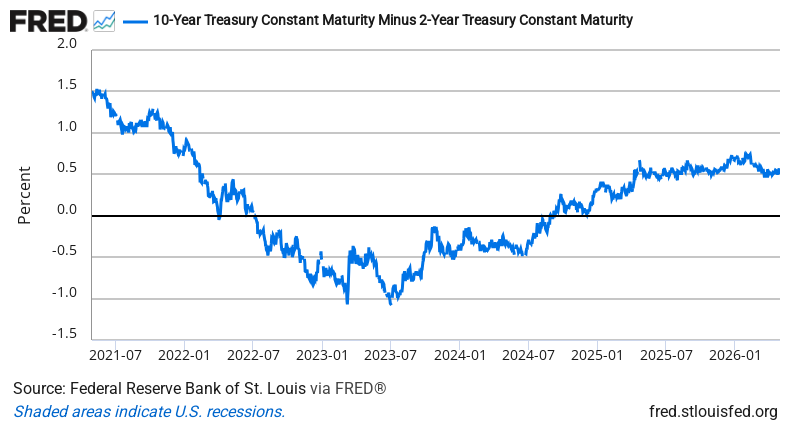
The 10-year minus 2-year Treasury spread widened to 0.5% yesterday, up from recent lows but still showing subtle day-to-day volatility around the half-percent mark. What’s interesting isn’t the daily wiggle — it’s that the curve has been steadily steepening since the Strait of Hormuz closure sent oil from $66 to $95, fundamentally altering the Fed’s rate path and growth expectations.
This gradual steepening tells a story about how bond markets are processing the energy shock. The curve had been flattening through early 2026 as markets expected Fed cuts, but that playbook got ripped up when the Strait closed in February. Now the long end is pricing in higher-for-longer rates as energy inflation threatens to push CPI prints into the 1-handle territory, while the short end reflects the Fed’s pause on easing. The spread’s move above 0.5% suggests bond traders think this isn’t a temporary oil spike — it’s a structural shift that changes the inflation-growth calculus.
Historically, a steepening curve in this range has been a mixed signal for risk assets. When steepening happens because growth expectations are rising (good), stocks love it. When it happens because inflation fears are pushing long rates higher while the Fed stays put (less good), equity markets get more selective. Given that offensive sectors are still outperforming defensive by 8.1 percentage points, many professional investors seem to be betting this steepening reflects resilient US growth rather than stagflation fears.
Bottom Line: The curve is whispering what energy markets are shouting — this oil shock isn’t temporary, and the Fed’s dovish pivot is officially on hold. Watch whether the spread pushes through 0.75% — that would signal bond markets expect the energy crisis to meaningfully reshape the interest rate landscape.
Source: Federal Reserve Economic Data (FRED)
ON1010.com provides economic education for investors. Nothing here is investment advice. Always consult a qualified financial advisor before making investment decisions.
Free Research
The economy moves fast. We make sure you move faster.
Economic data, policy shifts, and market signals — delivered to your inbox.
Subscribe Free