
The Yield Curve’s Slow Creep Back to Normal — But Is This the Right Time?
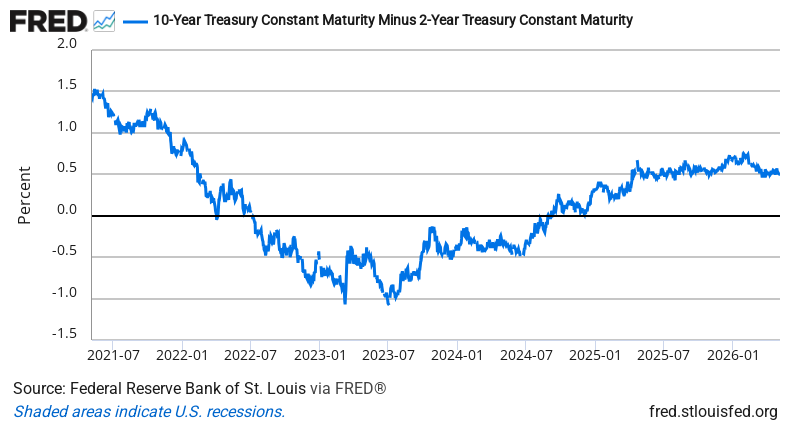
The 10-year/2-year Treasury spread narrowed slightly to 0.49% yesterday, down from 0.50% the day before. That’s the yield curve’s quietest move in weeks, but it masks a bigger question: should bond markets really be normalizing while the Strait of Hormuz remains closed?
Here’s the tension. A positive yield curve (longer rates above shorter ones) is the economy’s natural state — it signals investors expect growth ahead. We’ve been steadily climbing back from inversion territory since early this year. But this normalization is happening against the backdrop of an active military crisis that has oil trading near $95, up from $66 before the Strait closure. Historically, energy shocks don’t resolve this smoothly.
The spread’s gradual widening suggests bond investors see two competing forces: recession fears fading (good for longer-term bonds) but inflation risks rising (bad for them). With monthly CPI potentially printing with a “1-handle” due to energy costs, the Fed has already paused rate cuts. That leaves the yield curve caught between a recovering economy and persistent price pressures — a combination that rarely stays stable.
Many professional investors use yield curve movements to gauge recession risk, but in this environment, they’re also watching the curve’s speed of normalization. When curves steepen too fast, it often signals inflation expectations getting unmoored. When they normalize this gradually, it can mean the market is pricing in a soft landing — or that it’s not fully pricing in the energy shock.
Bottom Line: The yield curve is healing, but the patient is still running a fever. With oil markets disrupted and inflation risks elevated, this gradual normalization might be the calm before a much sharper steepening ahead.
Source: Federal Reserve Economic Data (FRED)
ON1010.com provides economic education for investors. Nothing here is investment advice. Always consult a qualified financial advisor before making investment decisions.
Free Research
The economy moves fast. We make sure you move faster.
Economic data, policy shifts, and market signals — delivered to your inbox.
Subscribe Free