
Productivity Powers Forward Despite Energy Crisis
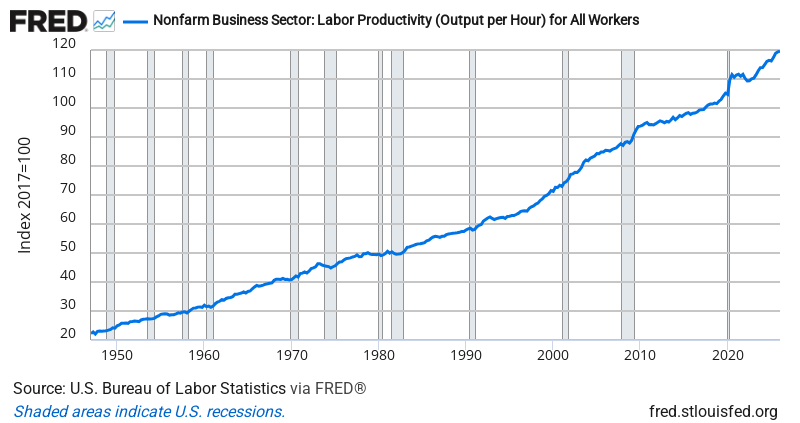
US productivity climbed 0.19% in the first quarter, marking nearly three percent annual growth — a remarkable performance given the economic turbulence from the Strait of Hormuz crisis. The 2.92% year-over-year gain represents the strongest productivity momentum since the AI investment boom began reshaping how work gets done.
This productivity surge is the economy’s best defense against the energy shock. When workers produce more per hour, companies can absorb higher input costs without crushing profit margins or triggering mass layoffs. That’s exactly what we’re seeing: despite oil jumping from $66 to $95 since the Strait closed in February, the economy is finding ways to do more with less. The recent trend shows consistent quarterly gains — a sharp contrast to the productivity stagnation that plagued the 2010s recovery.
The timing couldn’t be better. With the Fed pausing rate cuts due to energy-driven inflation fears, productivity growth gives the economy breathing room. Companies investing in automation and AI are seeing those bets pay off when they need efficiency most. Historically, productivity accelerations during supply shocks separate economies that adapt from those that stagnate.
Many professional investors view sustained productivity growth as the foundation for equity outperformance, particularly in technology and industrial automation sectors. In this environment, companies demonstrating measurable efficiency gains tend to command premium valuations, while productivity laggards face margin compression from higher energy costs.
Bottom Line: The economy is getting more productive faster than it’s getting more expensive — that’s the sweet spot that keeps expansions alive even when oil spikes.
Source: Federal Reserve Economic Data (FRED)
ON1010.com provides economic education for investors. Nothing here is investment advice. Always consult a qualified financial advisor before making investment decisions.
Free Research
The economy moves fast. We make sure you move faster.
Economic data, policy shifts, and market signals — delivered to your inbox.
Subscribe Free