
Fed Funds Target Rate (Lower Bound): Latest Release
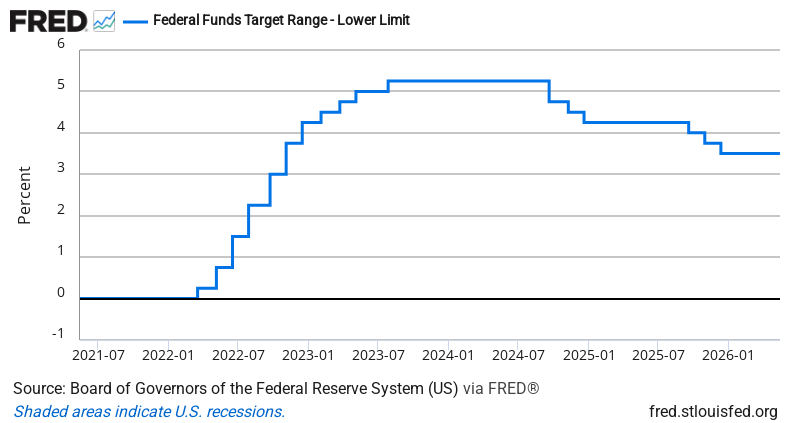
Fed Holds Rates Steady at 3.5% — But the Real Story Is What’s Not Happening
The Federal Reserve kept its target rate unchanged at 3.5% through mid-May, marking six straight days of policy paralysis as oil prices hover near $95 per barrel. What’s notable isn’t the hold itself — it’s that just three months ago, markets were pricing in multiple rate cuts by now.
The energy crisis changed everything. Before the Strait of Hormuz closure in late February, the Fed was eyeing a gradual easing cycle as inflation settled toward 2.5%. Now, with every sustained $10 oil spike adding roughly 0.6% to CPI, rate cuts have vanished from the conversation. The central bank is stuck — caught between an economy that was ready for lower borrowing costs and an energy shock that could push monthly inflation prints into the 1-handle range.
This policy freeze reveals a deeper tension in the current cycle. Corporate profit margins were expanding nicely through Q4 (up 9.2% annualized), setting up the classic conditions for business investment and hiring. But higher-for-longer rates mean that capital allocation story gets more complicated. Companies with strong cash flows can still invest and expand, but marginal projects and leveraged players face a tougher math problem.
Historically, when the Fed pauses during external shocks, professional investors focus on companies with pricing power — businesses that can pass through higher costs without losing market share. Energy exporters obviously benefit from the oil premium, but the real opportunity often lies in sectors insulated from both energy costs and interest rate sensitivity.
Bottom Line: The Fed’s 3.5% rate isn’t just a number — it’s a policy straitjacket. Until energy prices stabilize, don’t expect easing, and start thinking about which parts of the economy can actually thrive in a higher-rate world.
Source: Federal Reserve Economic Data (FRED)
ON1010.com provides economic education for investors. Nothing here is investment advice. Always consult a qualified financial advisor before making investment decisions.
Free Research
The economy moves fast. We make sure you move faster.
Economic data, policy shifts, and market signals — delivered to your inbox.
Subscribe Free