
Jobless Claims Jump 12,000 as Labor Market Sends Mixed Signals
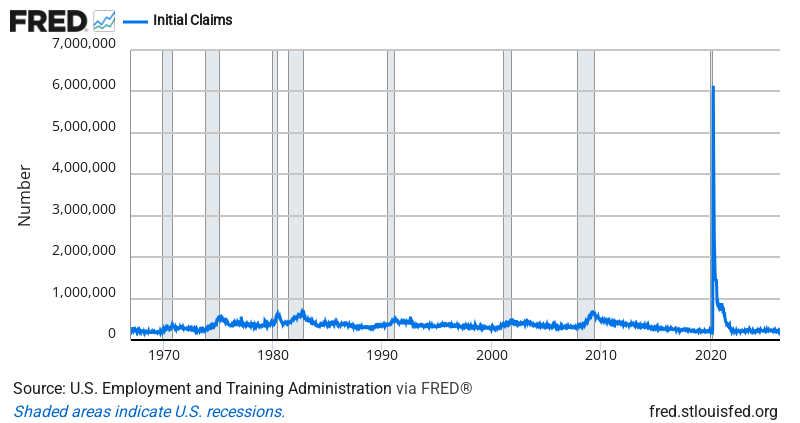
Initial jobless claims rose to 211,000 last week, up 12,000 from the previous week’s 199,000 reading. That’s the biggest weekly jump in a month, breaking what looked like a steady downtrend in layoffs.
But here’s the puzzle: even with this uptick, claims remain well below the 250,000 threshold that typically signals trouble. We’re seeing volatility around a very low baseline — the kind of choppiness you get when the job market is tight but businesses are becoming more selective about hiring and firing. The recent pattern shows claims bouncing between 190,000 and 218,000 over the past six weeks, suggesting employers are neither aggressively cutting nor desperately hoarding workers.
This fits with what we’re seeing elsewhere in the labor market: job openings are cooling from their post-pandemic peaks, but actual layoffs remain rare. Companies learned from the hiring scramble of 2021-2022 that it’s easier to slow hiring than to fire and rehire later. That creates a “soft landing” scenario where labor demand moderates without triggering mass unemployment.
For investors, this type of environment historically favors a barbell approach. Many professional traders focus on both defensive plays that can handle a slowing economy and growth stocks that can thrive if the soft landing succeeds. Bond investors often watch these weekly claims numbers closely — sustained readings above 300,000 typically signal recession risk, while numbers below 200,000 suggest the Fed might need to stay hawkish on rates.
Bottom Line: The job market is cooling, not cracking. The question is whether this measured deceleration can continue, or if something forces a sharper turn.
Source: Federal Reserve Economic Data (FRED)
ON1010.com provides economic education for investors. Nothing here is investment advice. Always consult a qualified financial advisor before making investment decisions.
Free Research
The economy moves fast. We make sure you move faster.
Economic data, policy shifts, and market signals — delivered to your inbox.
Subscribe Free