
Yield Curve Narrowing as Bond Markets Digest Energy Crisis
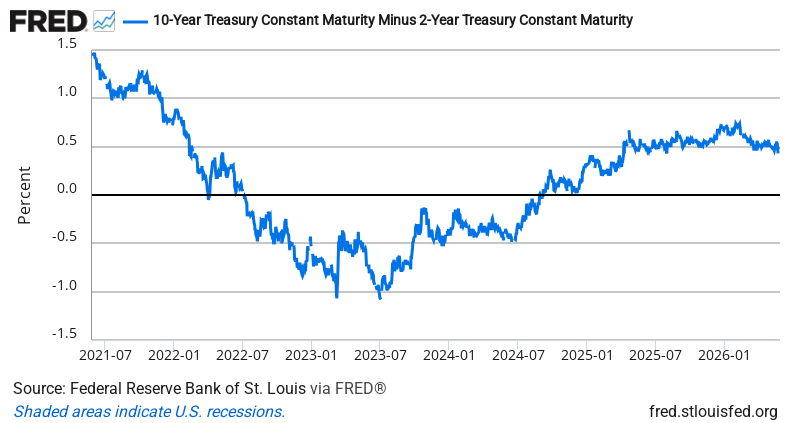
The gap between 10-year and 2-year Treasury yields compressed to 0.46% — the tightest in a week and down from 0.53% just six trading days ago. While still positive, this narrowing reflects bond traders grappling with a Fed that can’t cut rates while oil stays near $95.
The curve’s steady flattening since late May signals a shift in rate expectations. When the 10Y-2Y spread narrows, it typically means investors see slower growth ahead or believe the Fed will stay restrictive longer than previously thought. With the Strait of Hormuz still closed and energy inflation spiking, the Fed has effectively paused its easing cycle — leaving short-term rates elevated while longer-term bonds price in the economic drag from higher energy costs.
This dynamic is particularly notable because we’re seeing curve compression without inversion. The spread remains positive at 0.46%, but the trajectory matters. A sustained move below 0.25% would put us in “watch closely” territory, as every recession since 1970 has been preceded by curve inversion. For now, the flattening reflects policy uncertainty rather than recession fears — but the gap is closing.
What This Means for Your Portfolio: Historically, when yield curves flatten due to Fed hawkishness (rather than growth scares), many professional investors rotate toward shorter-duration assets and sectors that benefit from higher rates. Financials often outperform during curve flattening phases, while long-duration growth stocks face headwinds. The current environment favors strategies that don’t depend on rate cuts materializing.
Bottom Line: The curve is sending a clear message — rate cuts are off the table until energy prices stabilize. Watch for a break below 0.25% as the next key threshold.
Source: Federal Reserve Economic Data (FRED)
ON1010.com provides economic education for investors. Nothing here is investment advice. Always consult a qualified financial advisor before making investment decisions.
Free Research
The economy moves fast. We make sure you move faster.
Economic data, policy shifts, and market signals — delivered to your inbox.
Subscribe Free