
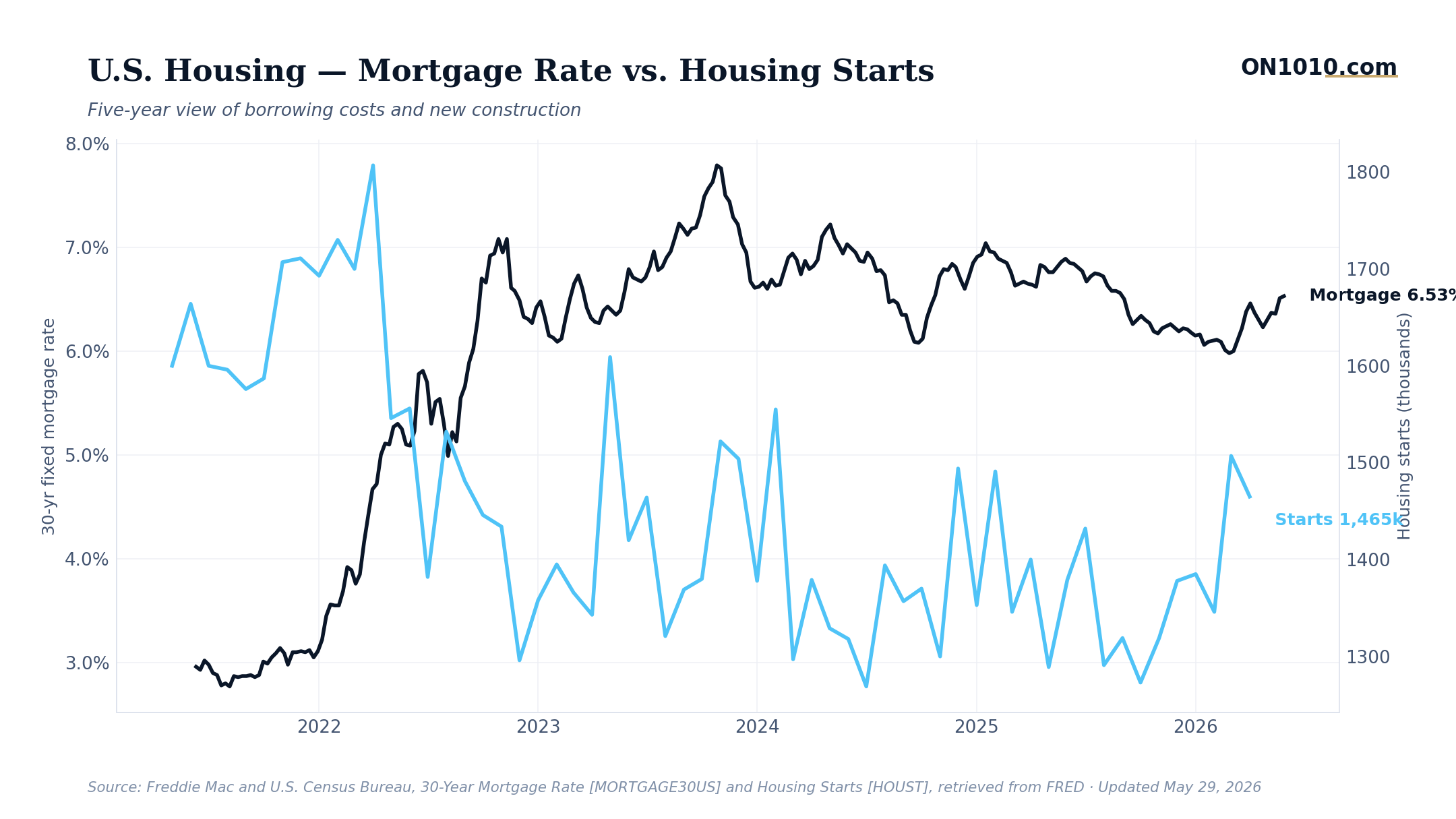
Mortgage Rates Hit 6.53% as Housing Affordability Reaches Breaking Point
The Opening Bell
Housing is officially in crisis mode. Mortgage rates just hit 6.53% for the fourth straight week of increases, while home prices remain near record highs and inventory stays painfully tight. Meanwhile, corporate profits are surging to new records thanks to a productivity boom, creating a tale of two economies: businesses thriving, homebuyers getting crushed.
Market Snapshot
Fed Funds Target Range: 3.5%-3.75%
10-Year Treasury: 4.48%
2-Year Treasury: 4.0%
10Y-2Y Spread: 0.46% (normal)
Breakeven Inflation (10Y): 2.39%
The yield curve continues normalizing with the 10Y-2Y spread at 0.46%, while inflation expectations hold remarkably steady despite ongoing energy disruptions. Bond markets are questioning whether the recent rate spike has legs.
What Moved Yesterday
The housing market delivered a reality check that nobody wanted to see. Mortgage rates climbing to 6.53% marks the highest level since late 2023 and puts homeownership further out of reach for millions of Americans. Here’s the math that matters: a $400,000 home now costs $2,780 per month at current rates, compared to $2,200 just six months ago when rates sat near 5.5%. That’s $580 more per month, or $6,960 annually, for the exact same house.
Corporate America, meanwhile, is having a very different experience. After-tax profits surged 3.3% to nearly $3.92 trillion in the latest quarter, powered by what can only be described as a productivity revolution. Companies are squeezing more output from every worker, every dollar of capital, every factory hour. When productivity rises this fast, profit margins expand even as wages increase. It’s the rare economic scenario where almost everyone should win, except housing costs are eating all the gains.
The disconnect is stark: businesses are optimizing at record pace while the housing market is effectively broken for new buyers. Rising productivity should eventually translate to higher wages and better living standards, but mortgage rates are rising faster than paychecks.
Today’s Playbook
Watch for any housing-related data or Fed commentary that addresses the affordability crisis. With rates at 6.53% and climbing, we’re approaching levels that could trigger a meaningful demand destruction in housing. The question is whether this represents a temporary spike tied to energy-driven inflation concerns or something more structural.
Corporate earnings season continues, and the productivity story bears watching closely. Companies reporting strong margin expansion despite wage pressures are demonstrating the kind of efficiency gains that historically drive sustained economic growth. But if housing costs keep rising, those productivity gains get absorbed by shelter inflation instead of improving living standards.
Keep an eye on Treasury action around the 4.5% level on the 10-year. If yields break higher, mortgage rates could push toward 7%, which would essentially freeze the housing market for first-time buyers.
The Bigger Picture
We’re witnessing a classic productivity boom running headlong into a housing shortage. The 1990s saw a similar pattern: technology-driven productivity gains, surging corporate profits, and a Federal Reserve trying to balance growth with inflation concerns. The difference? Housing supply was more elastic then. Today’s zoning restrictions, construction labor shortages, and NIMBY politics mean productivity gains can’t solve the housing crisis through market forces alone.
The risk is that housing becomes the economy’s Achilles heel. When shelter costs consume an outsized share of household budgets, even strong wage growth feels inadequate. We could end up with the paradox of a highly productive economy where workers can’t afford to live near their increasingly efficient jobs.
Bottom Line: Corporate America is firing on all cylinders with record profits and productivity gains, but the housing market is broken and getting worse. This productivity boom should be rocket fuel for the economy, but mortgage rates at 6.53% are turning it into a tale of haves and have-nots.
ON1010.com provides economic education for investors. Nothing here is investment advice. Always consult a qualified financial advisor before making investment decisions.
Free Research
The economy moves fast. We make sure you move faster.
Economic data, policy shifts, and market signals — delivered to your inbox.
Subscribe Free