
Treasury Curve Steepens as Markets Price Growth Over Recession Risk
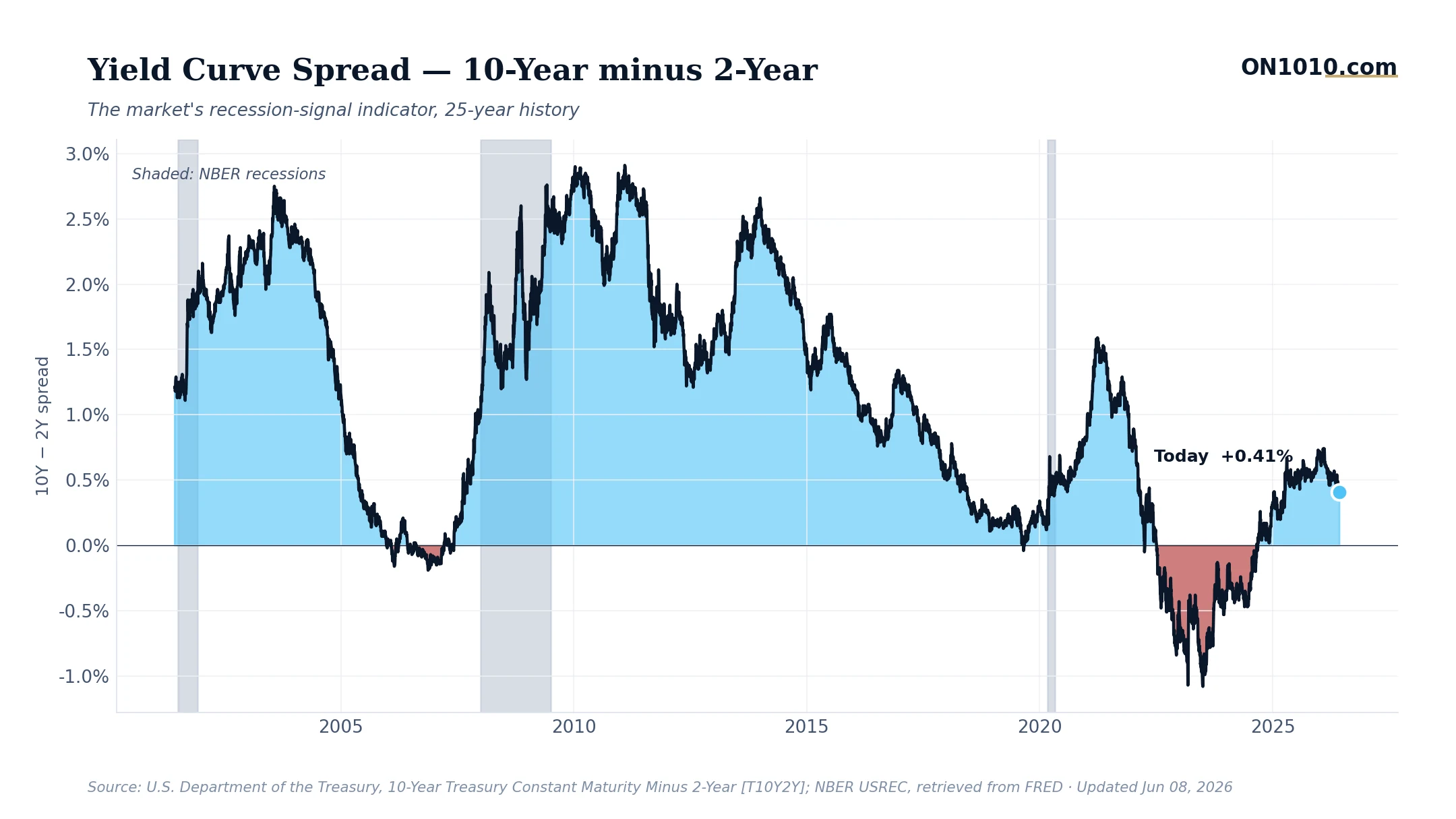
The 10-year minus 2-year Treasury spread widened to 0.41% on Friday, its highest level in three trading days and a meaningful move up from 0.38% earlier in the week. That 3 basis point jump represents a 7.9% increase in the spread, the kind of move that suggests bond traders are repositioning for a different economic outcome than they expected just days ago.
A steepening yield curve typically signals that markets see growth accelerating rather than slowing. When longer-term rates rise faster than shorter ones, it often means investors are pricing in stronger future economic activity, higher inflation expectations, or both. The recent move comes as the Fed has paused rate cuts due to energy-driven inflation pressures from the Strait of Hormuz crisis, leaving short rates anchored while longer yields adjust to a stickier inflation environment.
This steepening breaks from the recession playbook that dominated 2022-2023, when an inverted curve (negative spread) correctly anticipated economic slowdown concerns. The current positive spread suggests markets are betting on resilience rather than recession, consistent with the US benefiting as a net energy exporter during the current oil shock, even as energy-import-dependent economies face headwinds.
Historically, this type of steepening has coincided with periods when businesses start planning for expansion rather than contraction. In past cycles, investors have watched curve steepening as a signal that credit conditions may ease and that longer-duration assets could face pressure from rising rates. The pattern often precedes renewed corporate investment and hiring as confidence builds.
Bottom Line: Bond markets are pricing growth over recession risk, but the steepening curve also signals that the era of ultra-low long-term rates may be ending. The question for business leaders is whether this reflects genuine economic acceleration or just higher inflation expectations from the ongoing energy crisis.
Source: Federal Reserve Economic Data (FRED)
ON1010 Research is an independent publisher of economic education and is not a registered investment adviser, broker-dealer, or investment company. This content is for educational and informational purposes only and is not investment advice or a recommendation to buy, sell, or hold any security. Published under the publisher exemption recognized by Section 202(a)(11)(D) of the Investment Advisers Act of 1940 (Lowe v. SEC). Always consult a qualified financial professional before making any financial decision.
Free Research
The economy moves fast. We make sure you move faster.
Economic data, policy shifts, and market signals — delivered to your inbox.
Subscribe Free