
10-Year Treasury Holds Above 4.5% Despite Defensive Rotation
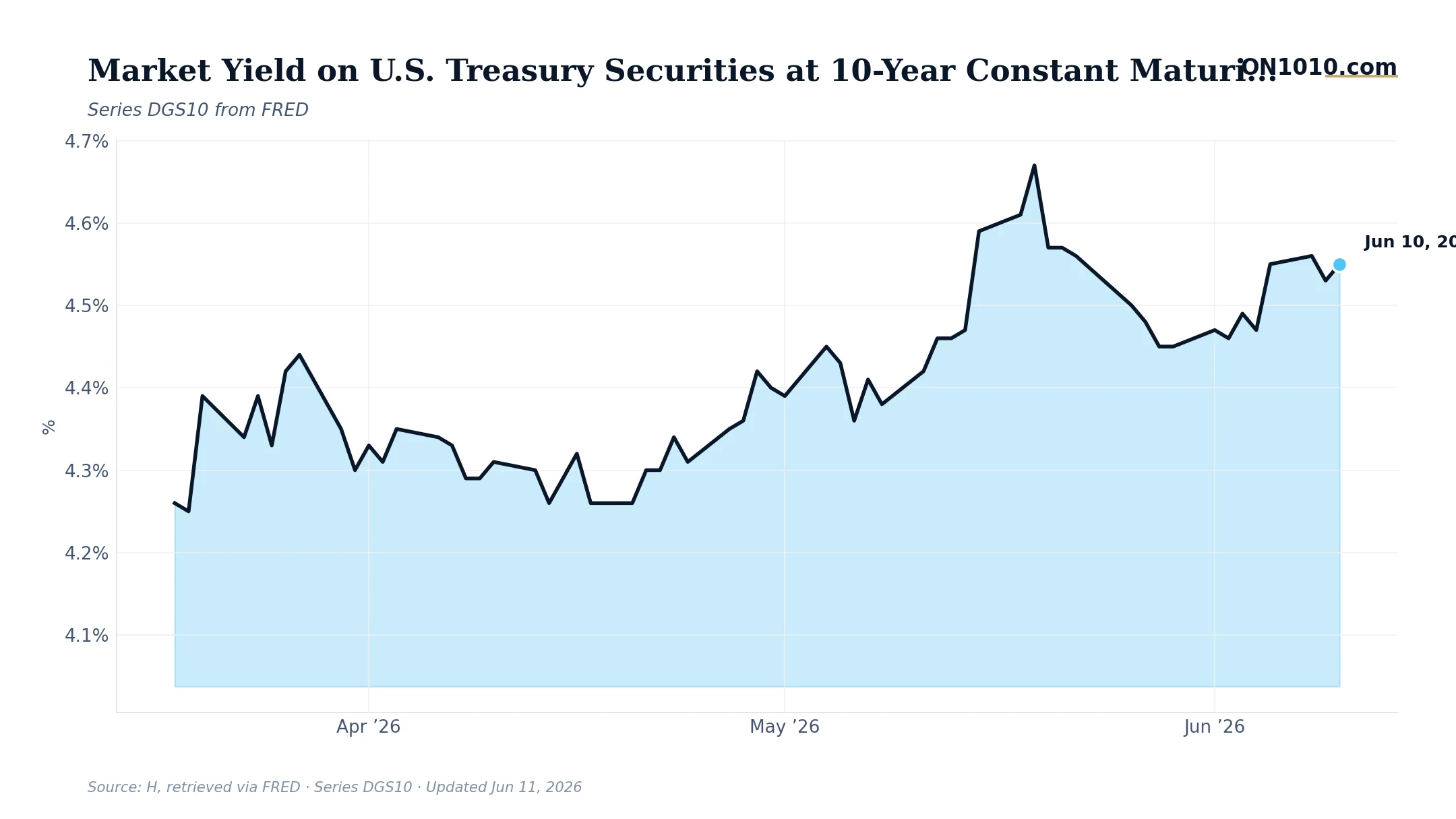
The 10-year Treasury yield ticked up to 4.55% Tuesday, a modest 2 basis point rise that keeps the benchmark rate firmly planted above the 4.5% threshold. What’s interesting isn’t the move itself, it’s that yields are holding steady even as money pours into defensive sectors and the VIX signals rising uncertainty.
This stability tells a story about inflation expectations. With oil trading near $95 following the Strait of Hormuz closure, bond investors aren’t betting on rate cuts anymore. The Fed has already paused easing as energy prices threaten to push monthly CPI readings into the 1-handle range. When energy shocks hit, the 10-year becomes an inflation gauge first, a growth indicator second.
The current setup echoes elements of the 1970s energy crises, when Treasury yields stayed elevated not because the economy was booming, but because investors demanded compensation for inflation risk. Today’s 4.55% yield reflects that same dynamic, bond holders pricing in the possibility that energy-driven price pressures stick around longer than anyone wants.
Historically, this type of yield behavior, holding firm during defensive sector rotation, has signaled that fixed income markets see inflation as the bigger near-term risk than recession. Corporate borrowers face higher financing costs just as margin pressures mount from energy expenses. Real estate transactions slow as mortgage rates follow the 10-year higher.
Bottom Line: When Treasury yields refuse to fall despite risk-off sentiment, the bond market is telling you something about the inflation outlook. The question worth asking: how long can the economy handle 4.5%+ borrowing costs with energy prices this elevated?
Source: Federal Reserve Economic Data (FRED)
ON1010 Research is an independent publisher of economic education and is not a registered investment adviser, broker-dealer, or investment company. This content is for educational and informational purposes only and is not investment advice or a recommendation to buy, sell, or hold any security. Published under the publisher exemption recognized by Section 202(a)(11)(D) of the Investment Advisers Act of 1940 (Lowe v. SEC). Always consult a qualified financial professional before making any financial decision.
Free Research
The economy moves fast. We make sure you move faster.
Economic data, policy shifts, and market signals — delivered to your inbox.
Subscribe Free