
The 10-Year Yield Is Creeping Higher. The Market Is Saying Something Else.
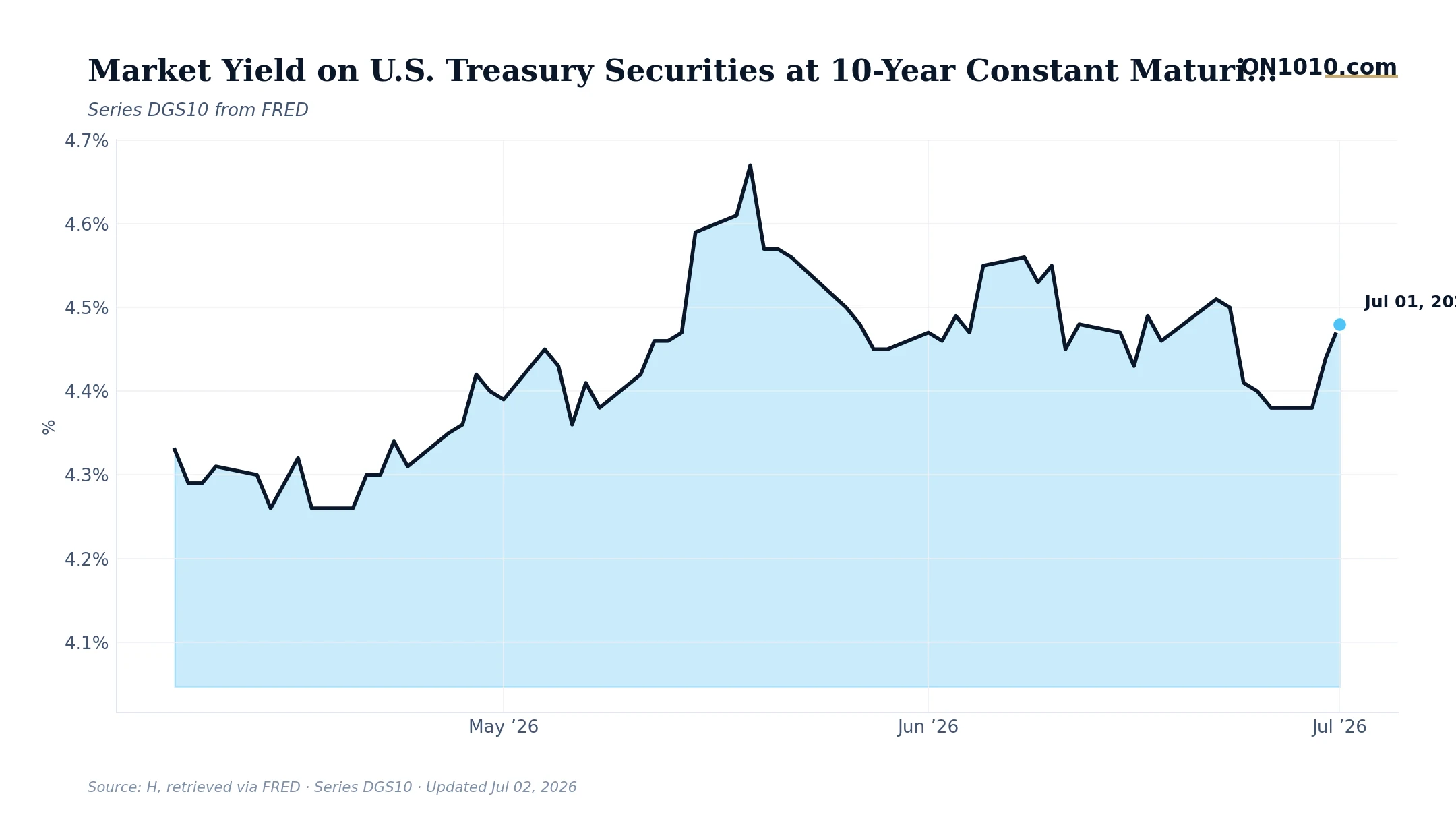
The 10-year Treasury yield rose to 4.48% on July 1, up from 4.38% just a few sessions earlier, a quiet but steady climb that has pushed the benchmark rate to its highest point in recent weeks. It’s not a dramatic spike. But directionally, the move is worth paying attention to.
Here’s the tension: yields are drifting higher, which usually signals optimism about growth or concern about inflation. Yet the sector rotation data tells a different story. Defensive sectors, health care, utilities, real estate, consumer staples, have all outperformed the broader market over the past month, with health care alone running nearly 10 percentage points ahead of SPY. That’s not the behavior of a market confident in acceleration. That’s a market hedging.
So you have a yield market nudging upward and an equity market rotating toward safety at the same time. Those two signals can coexist, but they’re not telling the same story, and that gap is worth sitting with.
For context, the 10-year yield is the economy’s central price signal. It sets the floor for mortgage rates, corporate borrowing costs, and the discount rate used to value future earnings. When it rises, financing gets more expensive and the present value of future profits shrinks, which tends to put pressure on growth stocks in particular.
Historically, a yield level in the mid-4% range has been manageable for corporate margins when productivity is rising and earnings are holding up. The question is whether the defensive rotation in equities is an early warning that margins are starting to feel the pressure, or simply a rotation trade with no deeper macro message behind it.
Bottom Line: The yield curve is tightening its grip on borrowing costs just as the equity market is quietly moving toward safety. Whether that’s caution or conviction is the question worth watching.
Source: Federal Reserve Economic Data (FRED)
ON1010 Research is an independent publisher of economic education and is not a registered investment adviser, broker-dealer, or investment company. This content is for educational and informational purposes only and is not investment advice or a recommendation to buy, sell, or hold any security. Published under the publisher exemption recognized by Section 202(a)(11)(D) of the Investment Advisers Act of 1940 (Lowe v. SEC). Always consult a qualified financial professional before making any financial decision.
Free Research
The economy moves fast. We make sure you move faster.
Economic data, policy shifts, and market signals — delivered to your inbox.
Subscribe Free