
Housing Starts Jump 6.2% as Builders Race Against Rate Uncertainty
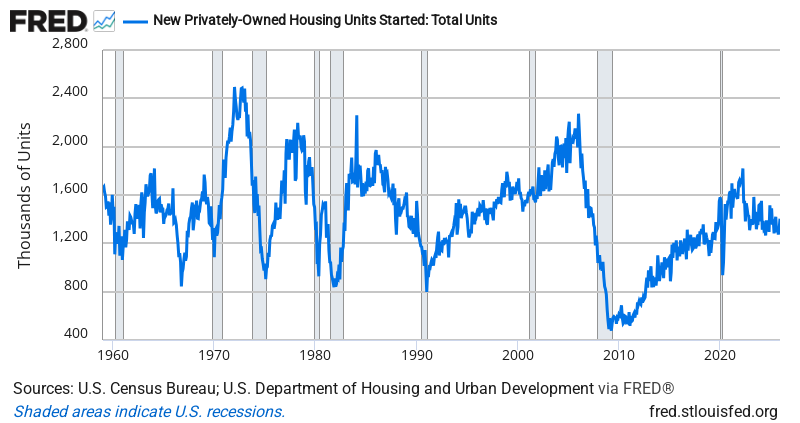
Housing starts surged 6.2% in December to 1.4 million units — the biggest monthly gain since July. But here’s the puzzle: starts are still down 5.8% from a year ago, and builders are facing their highest borrowing costs in over a decade.
This jump looks less like confidence and more like urgency. Homebuilders are racing to break ground on projects approved months ago, before construction financing gets even more expensive. The pattern fits what we’ve seen in past rate cycles — a final burst of activity before the credit squeeze really bites. Notice how starts spiked to 1.42 million in July, then wobbled for months before this latest push. That’s not steady growth; that’s stop-start behavior driven by financing windows.
The timing matters enormously for the broader economy. Housing starts are a leading indicator because they represent real capital allocation — developers putting serious money at risk based on where they think demand will be six months from now. When starts are volatile like this, it signals uncertainty about both credit conditions and consumer appetite. The fact that we’re seeing monthly gains but annual declines tells the story: short-term tactical moves, long-term structural headwinds.
In this type of environment, many professional investors focus on which parts of the housing ecosystem benefit from constrained supply. Historically, when new construction slows, existing home values get more support, and companies focused on home improvement rather than new builds tend to outperform. The winners often aren’t the obvious ones — think less about homebuilders, more about the scarcity value created by underbuilding.
Bottom Line: Builders are grabbing what they can before the window closes completely. The real question isn’t whether this pace is sustainable — it clearly isn’t — but how long the current financing environment keeps construction in this feast-or-famine cycle.
Source: Federal Reserve Economic Data (FRED)
ON1010.com provides economic education for investors. Nothing here is investment advice. Always consult a qualified financial advisor before making investment decisions.
Free Research
The economy moves fast. We make sure you move faster.
Economic data, policy shifts, and market signals — delivered to your inbox.
Subscribe Free