
Bond Markets Signal Fed Pause as 2-Year Treasury Yield Drops
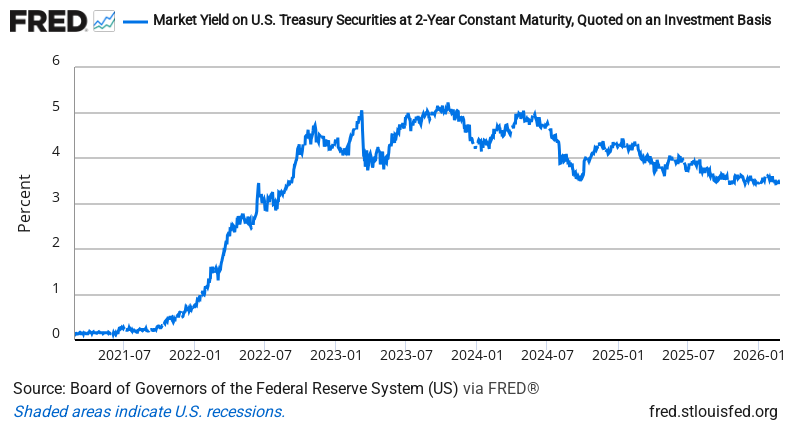
The 2-year Treasury yield fell to 3.43% on Friday, down from 3.48% earlier in the week — a modest but telling shift in what bond traders expect from the Federal Reserve’s next moves.
Here’s what’s interesting: the 2-year yield is the market’s best real-time gauge of Fed policy expectations, and it’s been bouncing around 3.40-3.50% for two weeks now. That narrow range suggests traders think the Fed is pretty much done with its rate cycle — no more hikes, but no urgent need to cut either. When the 2-year yield moves dramatically, it usually means the Fed is about to surprise everyone. When it moves sideways like this, it means the market thinks the central bank is on cruise control.
This fits with other signals we’ve been seeing. Inflation has cooled but hasn’t disappeared entirely, and the labor market remains surprisingly resilient. The Fed seems content to wait and see rather than make aggressive moves in either direction. Historically, when the 2-year yield trades in tight ranges around 3.5%, it suggests the Fed has found its “neutral” rate — the level that neither stimulates nor restricts the economy.
For investors, this type of environment often favors a barbell approach. Many professional portfolio managers use periods of Fed stability to position for whatever comes next — loading up on shorter-duration bonds to capture current yields while selectively adding longer-term assets that could benefit if rates eventually fall. The key is that 3.43% isn’t just a number — it’s the market saying “we think this is where rates live for a while.”
Bottom Line: When the 2-year yield moves sideways, smart money often starts preparing for the next cycle rather than chasing the current one.
Source: Federal Reserve Economic Data (FRED)
ON1010.com provides economic education for investors. Nothing here is investment advice. Always consult a qualified financial advisor before making investment decisions.
Free Research
The economy moves fast. We make sure you move faster.
Economic data, policy shifts, and market signals — delivered to your inbox.
Subscribe Free