
The Yield Curve Is Quietly Steepening — But Not for the Reasons You’d Expect
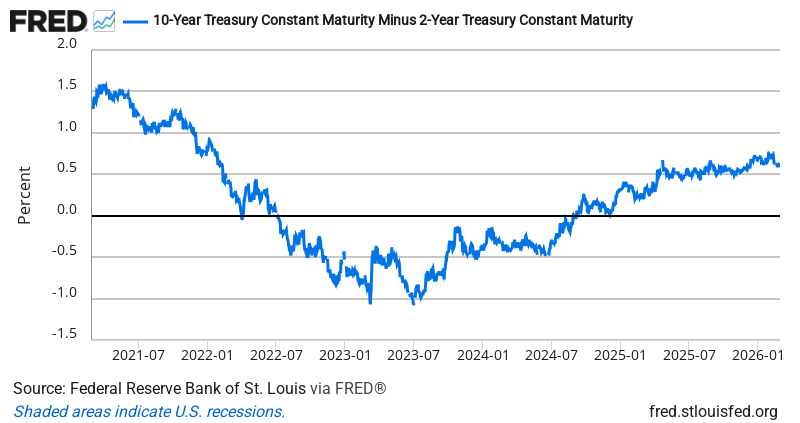
The 10-year/2-year Treasury spread ticked down to 0.59% yesterday from 0.60% — a tiny move that masks a much bigger story. After spending most of 2022 and 2023 inverted (the classic recession warning), this curve has been slowly steepening since late 2024. But here’s the puzzle: it’s not steepening because the Fed is cutting rates aggressively. It’s steepening because long-term rates are rising.
That’s unusual — and telling. Normally, yield curves steepen when the Fed cuts short-term rates to fight a recession while long rates stay put. This time, we’re seeing the opposite: short rates holding steady while the 10-year climbs. Bond investors are essentially saying they’re not worried about a recession (hence no panic buying of long bonds), but they are demanding higher compensation for longer-term risk. That’s consistent with an economy that’s growing faster than expected, not one heading for trouble.
The market is quietly repricing what normal looks like. With corporate profit margins at historic highs and productivity gains from AI investment starting to show up in the data, investors are adjusting to the possibility that growth stays stronger for longer. Higher trend growth means higher “neutral” interest rates — and bond yields that settle at levels we haven’t seen since before the 2008 crisis.
What this means for your portfolio: Many professional investors are rethinking their duration exposure in this environment. When yield curves steepen because long rates are rising (not short rates falling), it often signals that growth assets may have more room to run, while long-duration bonds face headwinds. Historically, this type of steepening has coincided with periods when investors rotate toward sectors that benefit from higher growth expectations — financials, industrials, and cyclical value plays.
Bottom Line: A steepening yield curve usually signals trouble ahead. This time, it might signal the opposite — an economy that’s found its footing and doesn’t need the Fed’s help anymore.
Source: Federal Reserve Economic Data (FRED)
ON1010.com provides economic education for investors. Nothing here is investment advice. Always consult a qualified financial advisor before making investment decisions.
Free Research
The economy moves fast. We make sure you move faster.
Economic data, policy shifts, and market signals — delivered to your inbox.
Subscribe Free