
Bond Market Hits the Snooze Button as 2-Year Treasury Yield Flatlines
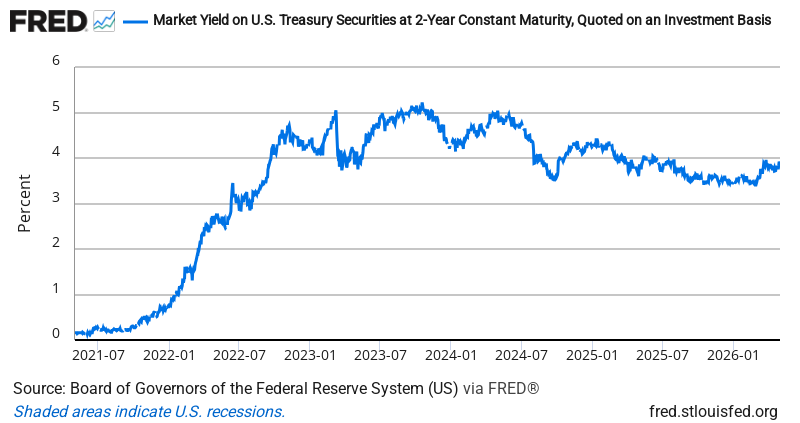
The 2-year Treasury yield held dead steady at 3.88% yesterday, capping off a week of sideways trading that suggests bond investors are in full wait-and-see mode.
This flatline action is actually telling a story. After bouncing around between 3.78% and 3.92% over the past week, the 2-year has settled into a tight range that screams uncertainty. Bond traders — who normally react to every Fed whisper and inflation data point — seem genuinely unsure about what comes next. That’s unusual for a market that prides itself on pricing in the future.
The 2-year yield is essentially the market’s best guess at where Fed rates will be over the next 24 months. When it’s stuck in neutral like this, it typically means one of two things: either the Fed has successfully communicated exactly where policy is headed (unlikely), or investors are split between competing scenarios. Given recent mixed signals on inflation and employment, the latter seems more probable. This kind of indecision often precedes bigger moves once clarity emerges — think of it as the market coiling up before a spring.
Historically, when the 2-year yield trades sideways for extended periods, many professional investors use the calm to position for volatility rather than direction. In this type of environment, bond traders often focus on the belly of the yield curve or consider strategies that benefit from eventual movement in either direction. The key is recognizing that low volatility rarely lasts forever in fixed income markets.
Bottom Line: A flat 2-year yield isn’t boring — it’s the bond market holding its breath. The question isn’t whether this sideways action will break, but which way it breaks when the next major economic data forces investors off the fence.
Source: Federal Reserve Economic Data (FRED)
ON1010.com provides economic education for investors. Nothing here is investment advice. Always consult a qualified financial advisor before making investment decisions.
Free Research
The economy moves fast. We make sure you move faster.
Economic data, policy shifts, and market signals — delivered to your inbox.
Subscribe Free