
Bond Market Sees Through the Noise: Inflation Expectations Hold Steady Despite Market Jitters
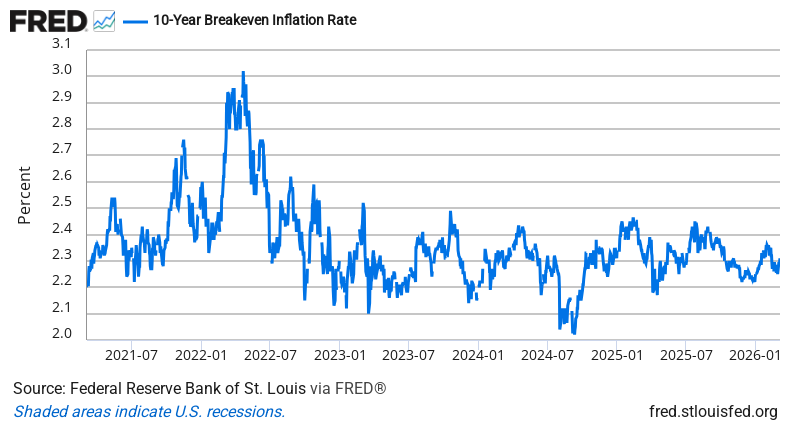
The 10-year breakeven inflation rate ticked up to 2.31% yesterday from 2.29% the day before, a modest 0.02 percentage point rise that tells a much more important story than the small move suggests. While equity markets have been rotating into defensive sectors amid elevated volatility, the bond market’s inflation gauge remains remarkably calm.
This stability is striking given the cross-currents hitting the economy right now. We’re seeing defensive sectors outperform growth by 6.5 percentage points over the past month, yet inflation expectations are barely budging from their recent range of 2.25% to 2.31%. That disconnect reveals something crucial: bond investors aren’t buying into the fear trade that’s driving money from tech into utilities.
The 2.31% reading sits comfortably above the Fed’s 2% target but well below levels that historically trigger policy panic. More importantly, it suggests markets see the current productivity cycle as genuinely disinflationary. When businesses invest in efficiency gains rather than just capacity expansion, they can grow without pushing up prices. That’s exactly what we’re seeing in the AI-driven investment boom.
Here’s what makes this data point particularly telling: breakeven rates derive from the difference between regular Treasury yields and Treasury Inflation-Protected Securities. When this spread holds steady while other risk assets get volatile, it means institutional investors see inflation as contained even if growth faces headwinds. They’re not demanding higher compensation for inflation risk despite all the policy uncertainty.
Historically, investors have used breakeven stability during market stress as a green light to stay positioned for growth rather than flee to cash. In environments like this, professional managers tend to focus on whether inflation expectations are anchored rather than whether the VIX is elevated.
Bottom Line: When inflation expectations stay boring while everything else gets exciting, that’s usually good news for risk assets once the volatility settles.
Source: Federal Reserve Economic Data (FRED)
ON1010.com provides economic education for investors. Nothing here is investment advice. Always consult a qualified financial advisor before making investment decisions.
Free Research
The economy moves fast. We make sure you move faster.
Economic data, policy shifts, and market signals — delivered to your inbox.
Subscribe Free