
Bond Markets Signal Fed Uncertainty as 2-Year Yields Jump
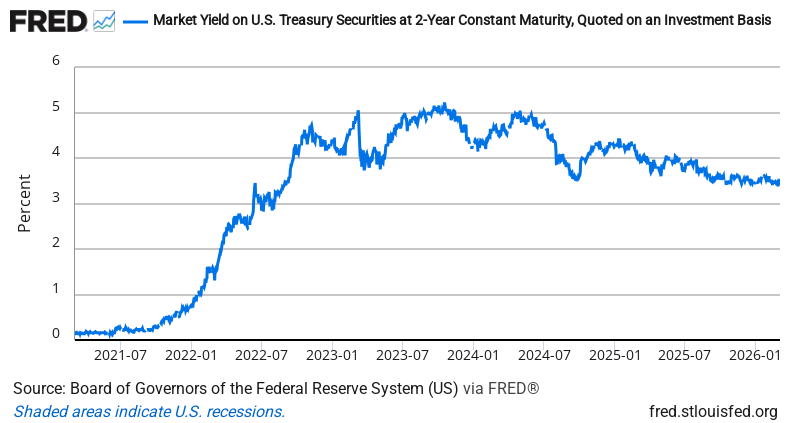
The 2-year Treasury yield climbed 3 basis points to 3.57% on March 5th, capping a sharp 19 basis point surge over the past week. That’s the fastest weekly rise since the banking crisis last March, and it’s telling a story the Fed might not want to hear.
Here’s what’s really happening: bond traders are repricing their expectations for Fed policy, and they’re not buying the “soft landing” narrative anymore. The 2-year yield is the market’s best guess at where Fed rates will be over the next 24 months. When it moves this fast, it means something fundamental shifted in how investors see the economic outlook.
The timing matters. This move coincides with defensive sectors crushing growth stocks over the past month. Utilities are up 10.3% versus the S&P 500, while financials are down 5.1%. That’s classic risk-off behavior. Money managers aren’t just repositioning for higher rates — they’re positioning for economic uncertainty.
What’s driving the repricing? Corporate profit margins are at historic highs and still expanding, which should keep the expansion intact. But the VIX spiked to 26.7 this week, well above its 20-day average of 20.4. Markets are pricing in volatility that doesn’t match the underlying economic data.
Historically, when 2-year yields rise this quickly while defensive sectors outperform, it signals either inflation concerns or growth worries. With core inflation at the Fed’s 2.1% target, this looks more like the latter. Professional managers are hedging against the possibility that something breaks in the credit cycle or that policy uncertainty creates economic drag.
Bottom Line: The bond market is sending a warning signal that doesn’t match the economic fundamentals — yet. When 2-year yields move this fast, it’s worth asking what institutional investors know that hasn’t shown up in the data.
Source: Federal Reserve Economic Data (FRED)
ON1010.com provides economic education for investors. Nothing here is investment advice. Always consult a qualified financial advisor before making investment decisions.
Free Research
The economy moves fast. We make sure you move faster.
Economic data, policy shifts, and market signals — delivered to your inbox.
Subscribe Free