
Bond Markets Signal Growing Fed Uncertainty as 2-Year Yield Bounces Around
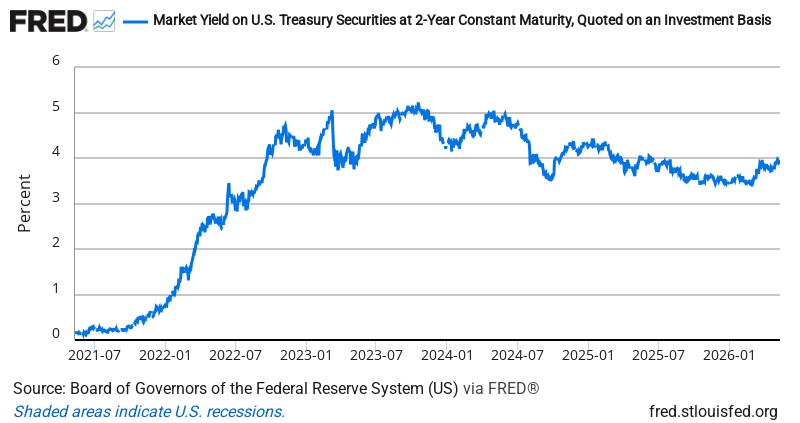
The 2-year Treasury yield jumped to 3.95% on Friday, up from 3.90% three days earlier — the latest swing in what’s becoming a choppy trading pattern. Over the past week, the yield has ping-ponged between 3.87% and 3.95%, a sign that bond traders can’t quite figure out what the Fed will do next.
This indecision matters because the 2-year yield is essentially the market’s best guess at where Fed rates will be in the near future. When it’s stable, investors have confidence in the Fed’s direction. When it bounces around like this, it suggests genuine uncertainty about whether the central bank will cut, hold, or even raise rates in the coming months. The 13 basis point trading range over five days might seem small, but for the ultra-sensitive 2-year note, it signals real disagreement about Fed policy.
The choppiness likely reflects conflicting economic signals — inflation data that won’t cooperate, employment numbers that keep surprising, and a Fed that’s been notably less committal in recent communications. When bond traders can’t read the Fed’s next move, they trade on every data point and Fed speech, creating exactly this kind of volatility. Historically, periods of 2-year yield volatility often precede significant policy shifts or economic turning points.
Many professional investors use 2-year yield volatility as a signal to diversify duration risk and reduce interest rate sensitivity in their portfolios. In uncertain Fed environments, some consider shorter-duration bonds or floating-rate instruments that adjust with changing rates. Others view the uncertainty itself as an opportunity, positioning for whichever direction becomes clear first.
Bottom Line: When the bond market can’t figure out the Fed, it usually means something important is about to shift — the question is what and when.
Source: Federal Reserve Economic Data (FRED)
ON1010.com provides economic education for investors. Nothing here is investment advice. Always consult a qualified financial advisor before making investment decisions.
Free Research
The economy moves fast. We make sure you move faster.
Economic data, policy shifts, and market signals — delivered to your inbox.
Subscribe Free