
Fed Funds Rate Locked at 3.64%: When Stability Becomes the Story
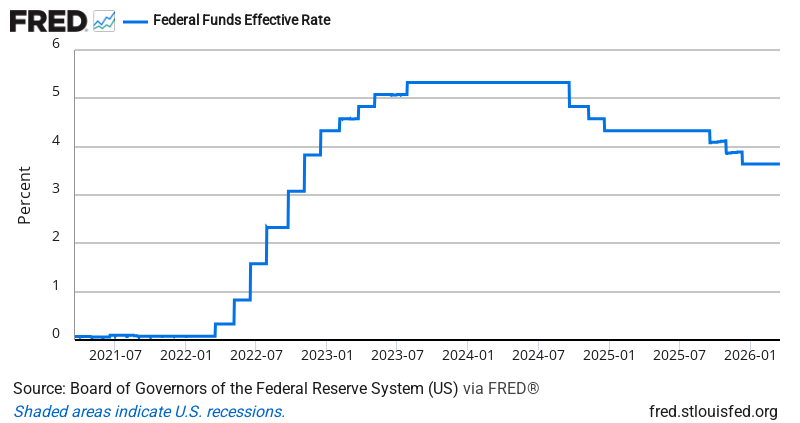
The effective federal funds rate held steady at 3.64% on March 18th, unchanged for six straight trading days. In a world where financial markets obsess over quarter-point moves, this rock-solid stability tells us something important about where we are in the monetary policy cycle.
This isn’t the Fed hitting pause between aggressive moves. This is what a policy rate looks like when it has found its sweet spot. At 3.64%, the overnight rate sits comfortably above core inflation (running around 2.1%) but well below the levels that typically choke off business investment. The margin between what banks pay for money and what they can earn lending it remains healthy enough to keep credit flowing.
Here’s what makes this interesting: the effective rate has been trading almost exactly at the Fed’s target midpoint for weeks. No stress, no volatility, no signs that banks are scrambling for liquidity or parking excess cash. When money markets run this smoothly, it usually means the broader financial system is functioning exactly as designed.
The stability also reflects something deeper about the current economic moment. With corporate profit margins still expanding and productivity gains from AI investment showing up in the data, businesses don’t need artificially cheap money to justify new projects. They’re finding profitable opportunities at market rates, which is exactly what you want to see in a healthy expansion.
Historically, investors have used periods like this to focus on fundamentals rather than Fed positioning. When monetary policy fades into the background, stock pickers can actually pick stocks based on earnings and growth prospects rather than interest rate sensitivity.
Bottom Line: A boring Fed funds rate is often a bullish signal — it means monetary policy is working so well that nobody has to think about it.
Source: Federal Reserve Economic Data (FRED)
ON1010.com provides economic education for investors. Nothing here is investment advice. Always consult a qualified financial advisor before making investment decisions.
Free Research
The economy moves fast. We make sure you move faster.
Economic data, policy shifts, and market signals — delivered to your inbox.
Subscribe Free