
Fed Funds Rate Stuck in Neutral — But the Silence Speaks Volumes
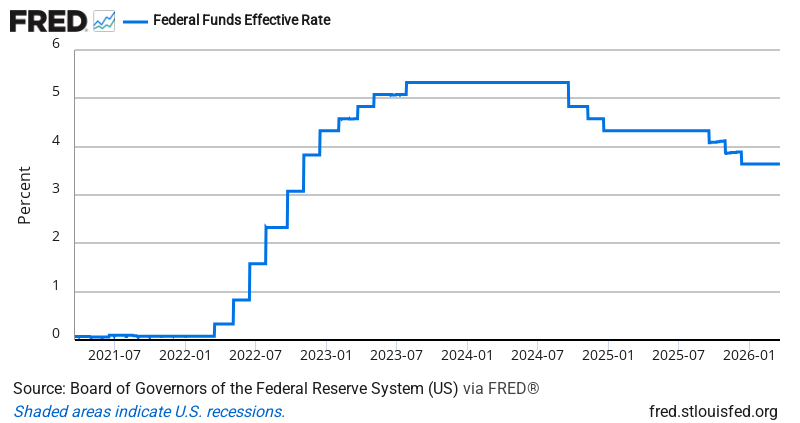
The effective federal funds rate held steady at 3.64% through March 20th, marking six consecutive trading days without movement. While that might sound boring, it’s actually telling us something important: the Fed’s transmission mechanism is working exactly as intended, even as markets price in extreme fear with the VIX above 30.
Here’s what most people miss about a flat fed funds rate. When this number stays rock steady, it means banks aren’t scrambling for overnight liquidity. No stress in the plumbing. The financial system is operating smoothly despite whatever headlines are spooking equity investors. Compare this to crisis periods when the effective rate bounces around the target as banks fight for funding.
The 3.64% level puts real short-term rates at roughly 1.4% after stripping out core inflation running around 2.2%. That’s restrictive but not punitive. Corporate profit margins are still expanding (up 9.2% annualized in Q4), which suggests businesses can handle this cost of capital just fine. When companies keep fattening margins despite higher borrowing costs, it signals the productivity gains from AI investment are real and structural.
What’s fascinating is the disconnect between this stable funding environment and the fear showing up in equity volatility. Professional money managers are rotating into defensive sectors, but the overnight lending market shows no panic whatsoever. This suggests the market stress is about uncertainty and positioning, not systemic financial risk.
Historically, when the fed funds rate trades this consistently at target during periods of equity volatility, it often marks a floor for risk assets. The 1998 Russian debt crisis and 2018 trade war tensions both featured similar patterns: funding markets stayed calm while stocks got choppy, then stocks recovered once the external uncertainty resolved.
Bottom Line: A boring fed funds rate during market turbulence usually means the turbulence is temporary, not structural. The question is whether investors recognize this disconnect before it closes.
Source: Federal Reserve Economic Data (FRED)
ON1010.com provides economic education for investors. Nothing here is investment advice. Always consult a qualified financial advisor before making investment decisions.
Free Research
The economy moves fast. We make sure you move faster.
Economic data, policy shifts, and market signals — delivered to your inbox.
Subscribe Free