
Fed Holds Pat at 3.5% as Energy Crisis Reshapes the Playing Field
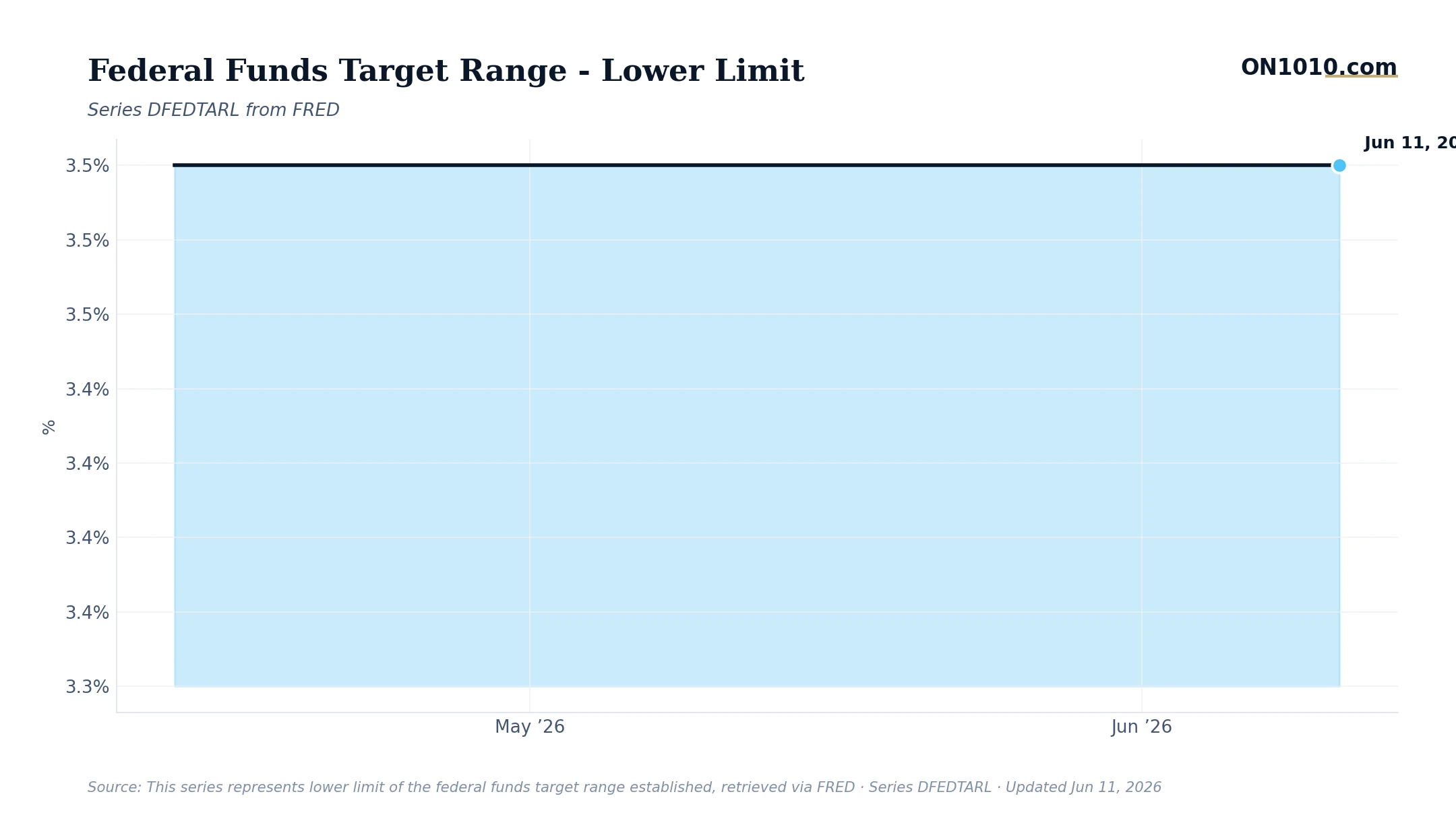
The Federal Reserve kept rates steady at 3.5% through mid-June, marking six consecutive sessions without movement as policymakers navigate the economic fallout from the Strait of Hormuz closure. What started as a potential easing cycle earlier this year has shifted into a strategic pause, with the central bank watching how a 44% oil price spike reshapes inflation dynamics.
This isn’t your typical Fed pause. The energy shock that pushed WTI crude from $66 to $95 following the military crisis in the Gulf has fundamentally altered the Fed’s calculus. Pre-crisis, both CPI and PCE were settling into a comfortable 2.5% annual rate. Now, with every sustained 10% oil premium adding roughly 0.6% to headline inflation, the Fed faces a scenario where monthly CPI readings could print with a 1-handle again. The pause reflects a central bank buying time to see whether energy-driven inflation proves transitory or structural.
Historically, Fed pauses during external supply shocks have lasted 6-12 months, depending on whether the shock reverses or becomes embedded in broader price expectations. The 1990 Gulf War pause lasted eight months; the 1979-80 Iranian crisis stretched longer as second-round effects took hold. Markets have already priced out near-term easing expectations, with defensive sectors outperforming growth by 3.4 percentage points over the past month as investors position for a higher-for-longer environment.
Bottom Line: The Fed’s patience here isn’t dovish or hawkish, it’s pragmatic. With the US as a net energy exporter, higher oil prices create cross-currents that don’t fit neatly into traditional policy frameworks. The question worth watching: does this pause stretch into 2027?
Source: Federal Reserve Economic Data (FRED)
ON1010 Research is an independent publisher of economic education and is not a registered investment adviser, broker-dealer, or investment company. This content is for educational and informational purposes only and is not investment advice or a recommendation to buy, sell, or hold any security. Published under the publisher exemption recognized by Section 202(a)(11)(D) of the Investment Advisers Act of 1940 (Lowe v. SEC). Always consult a qualified financial professional before making any financial decision.
Free Research
The economy moves fast. We make sure you move faster.
Economic data, policy shifts, and market signals — delivered to your inbox.
Subscribe Free