
Federal Funds Rate Locks In at 3.62%, The New Normal Takes Hold
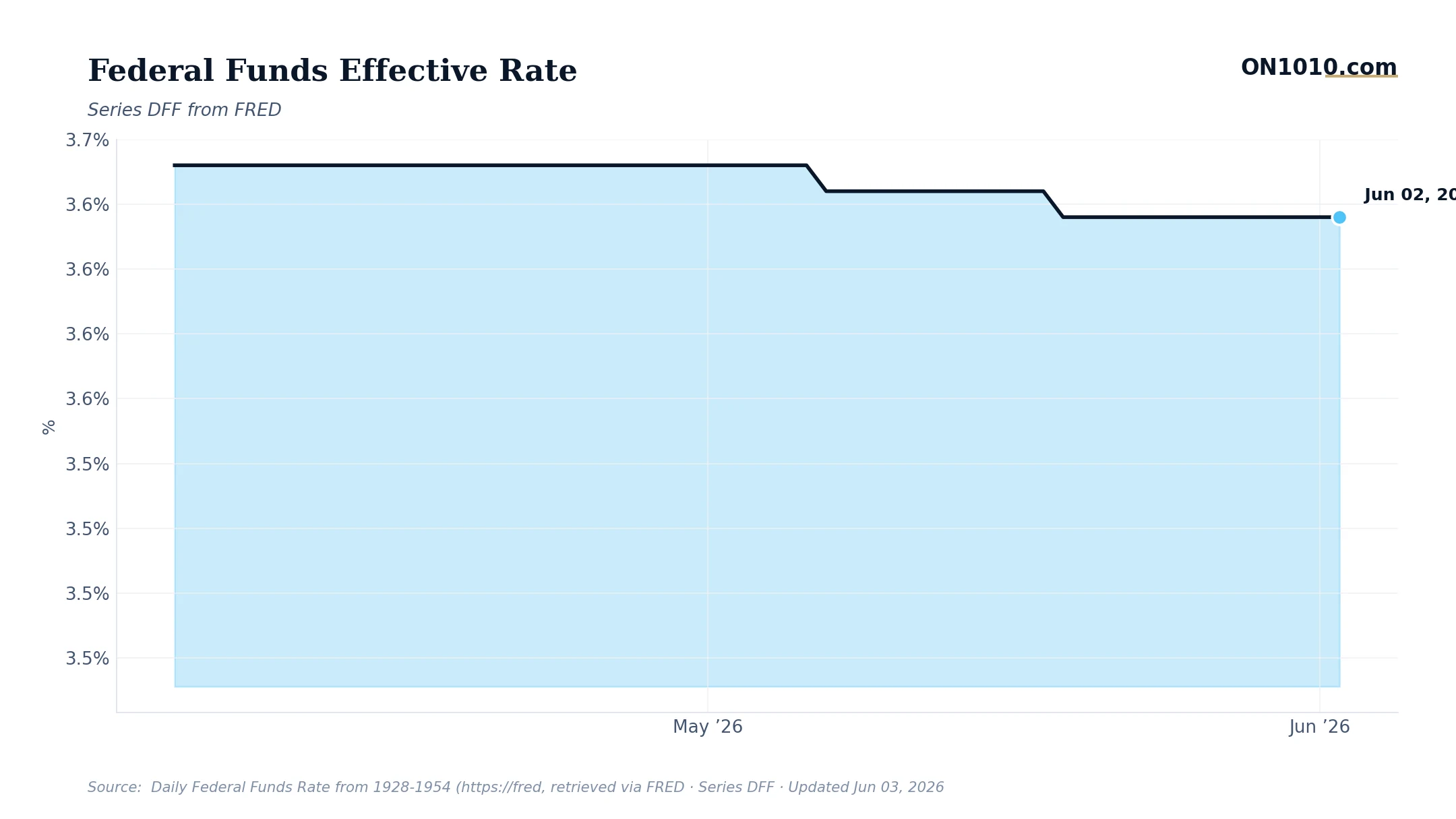
The effective federal funds rate has now sat unchanged at 3.62% for six straight trading days, cementing what appears to be the Fed’s new terminal position in response to the ongoing energy crisis. With oil trading near $95 after the Strait of Hormuz closure, the central bank has clearly shifted from cutting mode to holding pattern.
This isn’t just another pause between meetings, it’s the market pricing in a fundamentally different Fed stance. Before the energy shock hit in late February, markets were betting on continued rate cuts through 2026. Now, with every $10 oil premium adding roughly 0.6% to inflation, the Fed has effectively pivoted to “higher-for-longer” without even announcing it formally. The funds rate is finding its level organically as banks adjust to the new reality.
The stability at 3.62% suggests financial markets have absorbed the energy shock without major funding stress. Banks aren’t scrambling for overnight liquidity, and the rate isn’t spiking above the Fed’s target range. That’s actually encouraging, it means the plumbing still works even as the macro environment shifts dramatically. Historically, when major commodity shocks hit and rates stabilize quickly at a new level, it signals that markets are adapting rather than breaking.
Historically, this type of forced Fed pause during an external shock has meant a longer period of policy uncertainty. In past cycles, investors have watched the gap between what the Fed signals and what markets price, and that gap is now substantial. Business leaders planning capital investments face a completely different rate environment than they expected just months ago.
Bottom Line: The Fed has effectively moved to indefinite hold without saying so, and markets have accepted it. The question now is whether 3.62% is high enough to contain inflation if oil stays elevated through summer.
Source: Federal Reserve Economic Data (FRED)
ON1010 Research is an independent publisher of economic education and is not a registered investment adviser, broker-dealer, or investment company. This content is for educational and informational purposes only and is not investment advice or a recommendation to buy, sell, or hold any security. Published under the publisher exemption recognized by Section 202(a)(11)(D) of the Investment Advisers Act of 1940 (Lowe v. SEC). Always consult a qualified financial professional before making any financial decision.
Free Research
The economy moves fast. We make sure you move faster.
Economic data, policy shifts, and market signals — delivered to your inbox.
Subscribe Free