
Job Growth Slows to Crawl as Hiring Momentum Fades
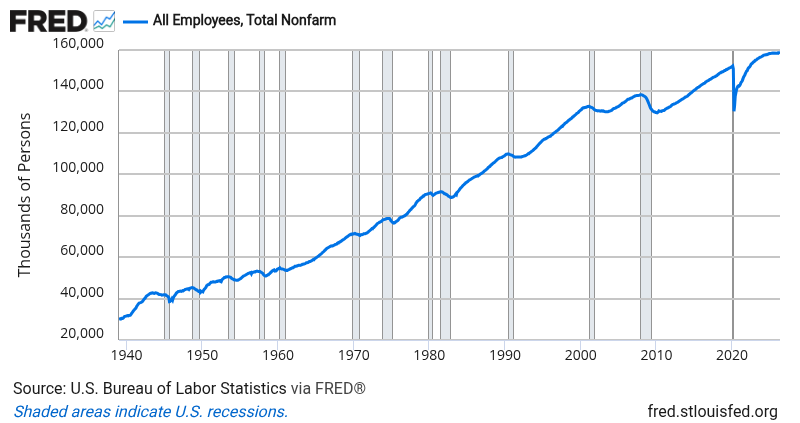
The U.S. economy added just 172,000 jobs in May, marking the weakest monthly gain since February and extending a troubling trend of decelerating hiring. That’s barely half the pace of job creation we saw in early 2024, when monthly gains routinely topped 300,000.
Here’s what’s telling: we’re not talking about job losses — we’re talking about an economy that’s shifting gears. Year-over-year job growth has slowed to 0.29%, the kind of pace you’d expect from a mature expansion running out of steam. The three-month average is now tracking below 200,000, a level that historically signals either late-cycle cooling or early recessionary warning signs.
This fits the broader narrative of an economy hitting capacity constraints. When unemployment is already near historic lows, businesses struggle to find workers even when they want to hire. The math is simple: fewer available workers means slower job growth, regardless of demand. What we’re seeing may be less about economic weakness and more about an economy bumping up against the limits of its labor supply.
For investors, this type of deceleration has historically prompted a shift toward quality over growth. Many professional portfolio managers start focusing on companies with strong balance sheets and stable cash flows when hiring momentum fades. Bond investors often view slowing job growth as potentially dovish for Fed policy, though with inflation still a concern, that calculus isn’t straightforward.
Bottom Line: The jobs machine is cooling, but the question isn’t whether hiring will slow — it’s whether this represents a healthy normalization or the start of something more concerning.
Source: Federal Reserve Economic Data (FRED)
ON1010.com provides economic education for investors. Nothing here is investment advice. Always consult a qualified financial advisor before making investment decisions.
Free Research
The economy moves fast. We make sure you move faster.
Economic data, policy shifts, and market signals — delivered to your inbox.
Subscribe Free