
Jobless Claims Hit a Wall at 213,000: Is the Labor Market Freezing Up?
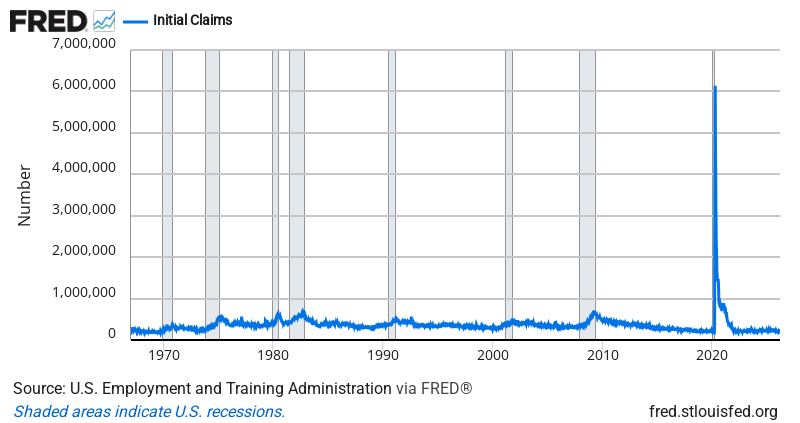
Initial jobless claims held dead flat at 213,000 last week, unchanged from the prior week and sitting right in the middle of a narrow range that’s defined the past six weeks. But here’s what’s interesting: this kind of stability in claims isn’t normal — and it might be telling us something important about where the labor market is headed.
Claims have been stuck in a 208,000 to 232,000 band since late January, with the weekly moves looking more like measurement noise than actual economic signal. That’s unusual. Typically, claims either trend steadily lower (companies getting more confident about hiring) or start climbing (layoffs picking up). This sideways drift suggests employers have found their comfort zone — they’re not panicking, but they’re not expanding either.
The bigger story is what this means for corporate profit margins, which have been the key driver of this expansion. When companies stop cutting jobs but also stop adding them aggressively, it often signals they’ve squeezed what they can from cost reduction and are waiting to see if revenue growth can justify more hiring. With claims holding steady around 213,000 — well above the sub-200,000 levels we saw through most of 2023 — it suggests businesses are being more cautious about their workforce planning.
Historically, when claims get stuck in a narrow range like this, it’s often a transition period. Either the economy accelerates and claims drop meaningfully, or confidence cracks and they start climbing. The current pattern looks similar to mid-2019, when claims plateaued before the pre-pandemic slowdown became visible in other data.
Bottom Line: A static labor market isn’t necessarily a healthy labor market — sometimes it’s just a patient one waiting for the next signal.
Source: Federal Reserve Economic Data (FRED)
ON1010.com provides economic education for investors. Nothing here is investment advice. Always consult a qualified financial advisor before making investment decisions.
Free Research
The economy moves fast. We make sure you move faster.
Economic data, policy shifts, and market signals — delivered to your inbox.
Subscribe Free