
Labor Market Sends Mixed Signals as Jobless Claims Drop Sharply
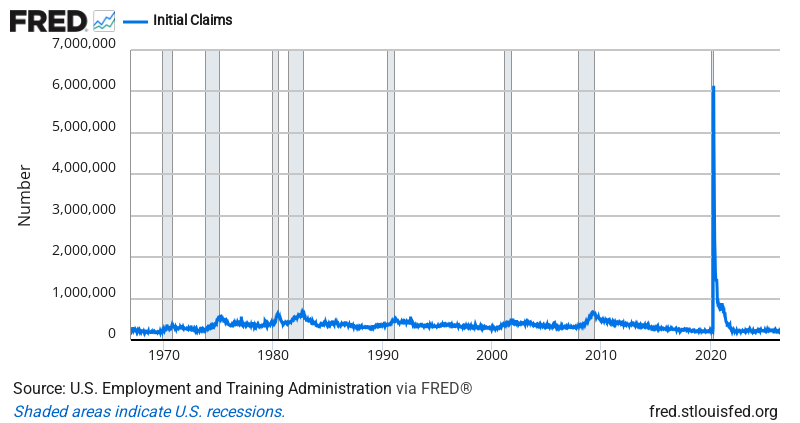
Initial jobless claims fell to 189,000 last week, down 26,000 from the prior week’s 215,000 reading. That’s the lowest level in three weeks — but it also highlights just how volatile this indicator has become lately.
The recent trend tells the story: claims have been bouncing between roughly 200,000 and 220,000 for the past month and a half, with last week’s sharp drop bringing us back toward the lower end of that range. This choppiness matters because jobless claims are supposed to be our early warning system for labor market shifts. When the signal gets noisy, it’s harder to spot real changes beneath the surface.
From a business cycle perspective, we’re in an unusual spot. Claims remain well below recession levels — anything consistently above 300,000 would be concerning — but the recent volatility suggests companies are making more frequent hiring and firing decisions. That often happens when businesses are uncertain about demand. They’re not panic-cutting yet, but they’re also not confident enough to ignore short-term fluctuations.
For investors, this creates a tricky environment. Many professional traders treat jobless claims as a leading indicator for both economic growth and Federal Reserve policy. When claims trend lower, it typically supports risk assets like stocks because it signals a healthy labor market. But when the data gets choppy like this, it becomes harder to position for clear directional moves. Historically, periods of elevated claims volatility have led investors to focus more on company-specific fundamentals rather than broad economic themes.
Bottom Line: The labor market isn’t flashing red, but it’s not giving clear green signals either. In environments like this, the next few weeks of data matter more than any single reading.
Source: Federal Reserve Economic Data (FRED)
ON1010.com provides economic education for investors. Nothing here is investment advice. Always consult a qualified financial advisor before making investment decisions.
Free Research
The economy moves fast. We make sure you move faster.
Economic data, policy shifts, and market signals — delivered to your inbox.
Subscribe Free