
Productivity Growth Hits 2.8% — The Economy’s Best-Kept Secret Just Got Better
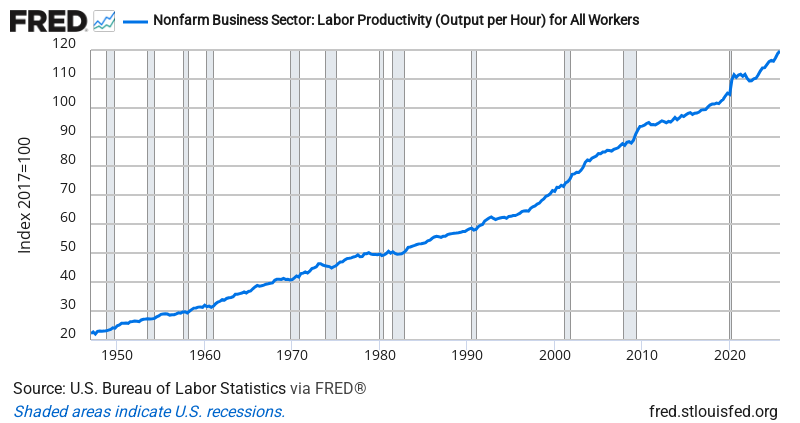
Here’s a number that should make everyone feel optimistic: productivity jumped 2.8% year-over-year in Q3, with output per hour worked rising 0.7% just in the quarter. That’s the kind of sustained productivity growth the U.S. economy hasn’t seen consistently since the late 1990s tech boom.
This matters more than almost any other economic indicator because productivity growth is what lets the economy have its cake and eat it too. When workers produce more per hour, companies can afford to pay higher wages without squeezing profit margins — and they can do it without triggering inflation. The index now sits at 119.6, meaning American workers are producing nearly 20% more per hour than they were in 2017. That’s not just post-pandemic recovery anymore; that’s structural improvement.
The timing is particularly interesting. We’re seeing this productivity surge alongside a cooling labor market and persistent (but moderating) inflation. Historically, this combination has created some of the economy’s sweetest spots — periods where growth continues but inflationary pressures ease naturally through efficiency gains rather than economic pain.
For investors, sustained productivity growth typically creates a rising tide environment. Many professional investors view productivity booms as supporting both corporate earnings growth and stock market multiples, since companies can grow profits without the margin pressure that usually comes with tight labor markets. Bond investors also tend to benefit, as productivity-driven growth is less inflationary than demand-driven growth, potentially giving the Fed more room to ease policy.
Bottom Line: This isn’t just another quarterly bounce — productivity growth at these levels suggests the U.S. economy may have genuinely shifted into a higher gear, creating the foundation for non-inflationary growth that could reshape investment landscapes.
Source: Federal Reserve Economic Data (FRED)
ON1010.com provides economic education for investors. Nothing here is investment advice. Always consult a qualified financial advisor before making investment decisions.
Free Research
The economy moves fast. We make sure you move faster.
Economic data, policy shifts, and market signals — delivered to your inbox.
Subscribe Free