
The 10-Year Treasury Just Hit 4.42% — Here’s Why That’s the Real Story
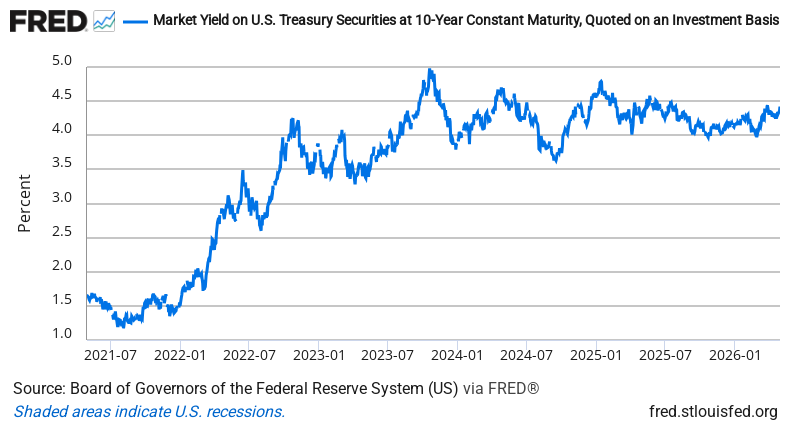
The 10-year Treasury yield jumped 6 basis points to 4.42% yesterday — its highest level in over a week and part of a steady climb that’s pushed rates up 12 basis points in just five trading days.
This isn’t just number noise. Bond yields are the economy’s pricing mechanism for future growth and inflation expectations. When the 10-year climbs this steadily, it’s telling us something important about what investors see coming. Either they expect stronger economic growth (good) or higher inflation (not so good) — and right now, at 4.42%, we’re testing levels that historically start to matter for everything from mortgage rates to stock valuations.
Here’s the key insight most people miss: the 10-year Treasury is the baseline rate for the entire economy. Corporate bonds price off it. Mortgage rates track it closely. And crucially, when the 10-year gets above 4.50%, it historically becomes a serious competitor to stocks — especially growth stocks that don’t pay dividends. We’re 8 basis points away from that psychological threshold.
The steady march higher suggests bond investors aren’t buying the “rates are going down soon” narrative anymore. Something has shifted in their expectations about either growth or inflation — and that shift is worth paying attention to.
In this type of environment, many professional investors start looking more carefully at sectors that benefit from higher rates — financials, for instance — while reconsidering growth stocks that struggle when borrowing costs rise. Value stocks with strong cash flows also tend to hold up better when the risk-free rate climbs.
Bottom Line: When the 10-year Treasury moves this deliberately higher, it’s not just about bonds — it’s repricing risk across the entire market. The question investors should be asking: what do bond traders see that equity investors might be missing?
Source: Federal Reserve Economic Data (FRED)
ON1010.com provides economic education for investors. Nothing here is investment advice. Always consult a qualified financial advisor before making investment decisions.
Free Research
The economy moves fast. We make sure you move faster.
Economic data, policy shifts, and market signals — delivered to your inbox.
Subscribe Free