
The 2-Year Treasury Just Flashed a Mixed Signal on Fed Policy
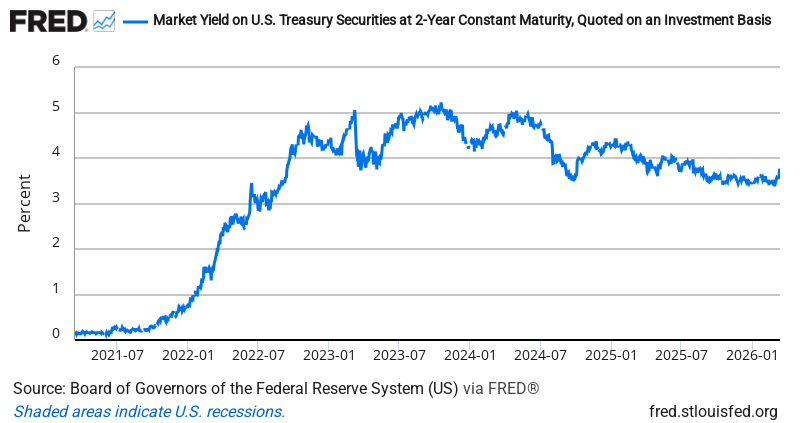
Bond markets are having a conversation with themselves about what comes next. The 2-year Treasury yield dropped to 3.68% yesterday from 3.73% last Friday — a small move that caps off a week of unusual volatility for a typically steady corner of the market.
Here’s what’s interesting: over just six trading days, the 2-year has ping-ponged from 3.56% to 3.76% and back down again. That’s not normal behavior for the bond that’s supposed to be the market’s best guess at near-term Fed policy. When the 2-year gets jumpy, it usually means investors are genuinely uncertain about what the central bank will do next — or they’re getting conflicting signals from the data.
The bigger story here is what this indecision reveals about the current economic moment. Two-year yields typically move in tight ranges when Fed policy is predictable. But we’re in an environment where multiple economic forces are pulling in different directions: inflation that’s still above target, a labor market that’s cooling but not crashing, and productivity gains that could change the whole inflation equation. Bond traders are essentially saying “we’re not sure what the Fed is thinking because we’re not sure what the economy is doing.”
For portfolios, this kind of yield volatility in short-term Treasuries often signals a shift in the investment landscape. Many professional investors use periods of 2-year uncertainty to reassess their interest rate exposure. Historically, when short-term bond markets can’t find their footing, it’s often because we’re approaching an inflection point where the Fed’s next move becomes clearer.
Bottom Line: When the bond market’s most reliable policy barometer starts wobbling, it’s usually worth paying attention to what economic data comes next.
Source: Federal Reserve Economic Data (FRED)
ON1010.com provides economic education for investors. Nothing here is investment advice. Always consult a qualified financial advisor before making investment decisions.
Free Research
The economy moves fast. We make sure you move faster.
Economic data, policy shifts, and market signals — delivered to your inbox.
Subscribe Free