
The Bigger Picture
The Job Market’s Quiet Resilience Just Got a Little Louder
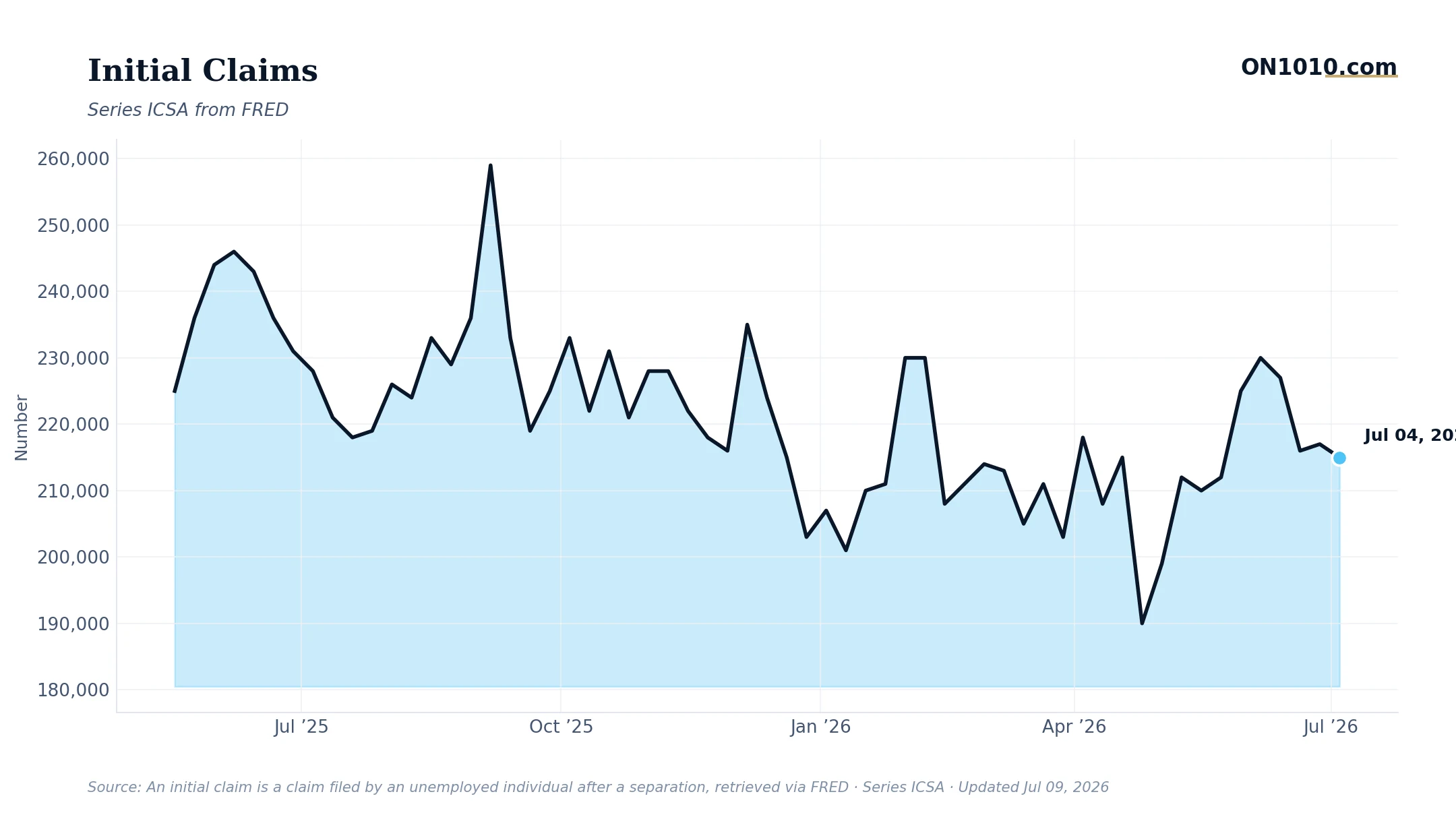
Initial jobless claims fell to 215,000 for the week ending July 4, down from 217,000 the prior week. That is a small move in isolation, but zoom out and the story gets more interesting: claims have now dropped nearly 7% in just four weeks, falling from 230,000 in early June to where they sit today.
This is not a trembling economy. This is a labor market that keeps refusing to crack.
Four weeks ago, claims were nudging toward levels that historically spark concern about softening conditions. Instead, they reversed sharply, and this week’s reading sits comfortably in the range that economists associate with a healthy, stable job market. That matters because jobless claims are one of the fastest-moving economic indicators we have. They update weekly. They are not revised much. When they drop this consistently, it signals that layoffs are not picking up, and employers are holding on to their workers. For an economy navigating tariff uncertainty and the tail end of a rate-tightening cycle, that is a meaningful signal.
Why It Matters
Historically, sustained claims readings below 225,000 have coincided with tight labor markets, solid consumer spending, and expanding corporate margins, because companies that are not laying people off are usually doing well enough not to need to. In past cycles, investors have watched claims data closely as an early read on whether profit margins were likely to hold. When claims creep higher, it often precedes the kind of cautious hiring and spending pullback that eventually shows up in earnings. Right now, that scenario is not playing out.
It is worth noting, though, that markets are showing a mild defensive tilt this week, with Health Care and Consumer Staples outperforming. The data and the market are not exactly singing the same song. That tension is worth watching.
Bottom Line: The labor market is giving economists very little to worry about right now. The real question is whether that strength can hold if consumers start to feel the pinch from trade policy, and whether the defensive rotation in markets is early signal or just noise.
Source: Federal Reserve Economic Data (FRED)
ON1010 Research is an independent publisher of economic education and is not a registered investment adviser, broker-dealer, or investment company. This content is for educational and informational purposes only and is not investment advice or a recommendation to buy, sell, or hold any security. Published under the publisher exemption recognized by Section 202(a)(11)(D) of the Investment Advisers Act of 1940 (Lowe v. SEC). Always consult a qualified financial professional before making any financial decision.
Free Research
The economy moves fast. We make sure you move faster.
Economic data, policy shifts, and market signals — delivered to your inbox.
Subscribe Free