
The Yield Curve Is Back to Normal. That’s Actually the Weird Part.
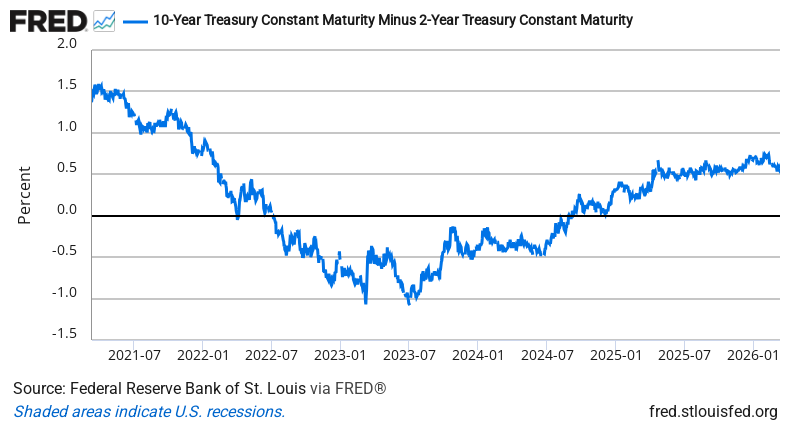
The 10-year to 2-year Treasury spread sits at 0.57%, barely changed from yesterday’s 0.58%. After nearly two years of an inverted yield curve screaming recession, we’re back to normal: longer bonds pay more than shorter ones. The puzzle isn’t that the curve uninverted. It’s that the economy never followed the historical script.
Since 1955, every recession has been preceded by an inverted yield curve. The signal was so reliable that traders called it the “magic 8-ball” of economic forecasting. When the curve flipped negative in July 2022 and stayed there for most of 2023 and 2024, recession calls poured in. Yet here we sit in March 2026, with corporate profits at historic highs and still expanding, unemployment near multi-decade lows, and productivity gains accelerating.
The uninversion itself tells us something important about where capital is flowing now. When long rates rise relative to short rates (steepening the curve), it usually signals that investors expect stronger growth ahead. Bond buyers demand higher compensation for locking up money for a decade if they think inflation or growth will surprise higher. The spread has bounced between 0.55% and 0.59% over the past week, suggesting markets are still calibrating what normal growth looks like in this AI-driven productivity cycle.
What changed this time? The recession signal may have been real, but the recession got crowded out by a structural shift the yield curve couldn’t price: artificial intelligence driving productivity gains that look more like the mid-1990s tech boom than a typical late-cycle expansion. When companies can squeeze more output from the same inputs, they can grow without the inflationary pressures that typically force the Fed to slam the brakes.
Bottom Line: A normal yield curve in an abnormal economy. The curve uninverted because the recession it predicted got replaced by a productivity boom that rewrote the rules.
Source: Federal Reserve Economic Data (FRED)
ON1010.com provides economic education for investors. Nothing here is investment advice. Always consult a qualified financial advisor before making investment decisions.
Free Research
The economy moves fast. We make sure you move faster.
Economic data, policy shifts, and market signals — delivered to your inbox.
Subscribe Free