
The Yield Curve Stays Put: Why This Boring Number Is Actually Big News
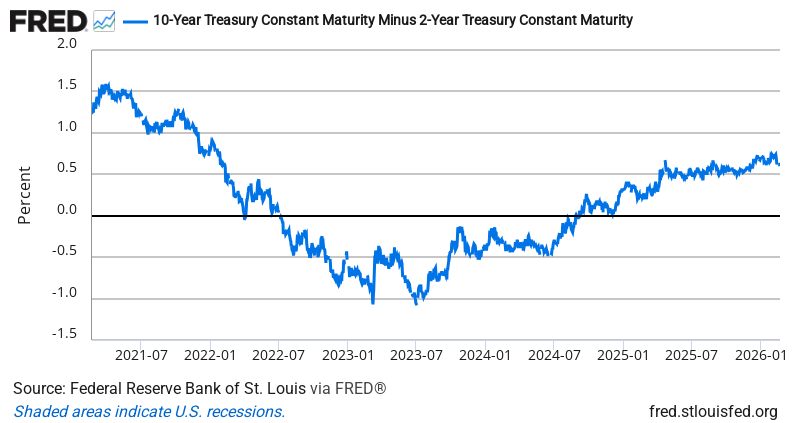
The 10-year-2-year Treasury spread held steady at 0.6% this week, barely budging from its recent range. That might sound like market-moving excitement on par with watching paint dry — but this stability is actually telling us something important about where we stand in the economic cycle.
For context: when this spread goes negative (the dreaded “inverted yield curve”), it has correctly predicted every recession since the 1960s. Right now, at 0.6%, we’re in what pros call a “normally sloped” curve — exactly where you’d expect to see it during a healthy growth phase. The Fed has been cutting rates while longer-term yields reflect steady growth expectations, creating this textbook setup. What’s notable is how stable this spread has become after the wild swings of 2022-2024, when it spent months deeply inverted before normalizing.
This stability aligns with the broader story emerging from recent data: corporate profit margins remain historically fat and expanding, capital investment is surging (even if much of it flows to foreign equipment), and the underlying productivity cycle shows no signs of breaking down. A stable, positive yield curve typically accompanies periods when businesses see clear profit opportunities ahead — which drives the investment and hiring that sustains growth.
For investors, this environment has historically favored strategies that benefit from steady growth rather than dramatic economic shifts. Many professional investors use stable, positive yield curves as a green light for equity exposure, while also considering longer-duration bonds as rates appear to be settling into a range rather than trending sharply in either direction.
Bottom Line: Sometimes the most important economic signal is the absence of a signal — and right now, the yield curve is saying “steady as she goes.”
Source: Federal Reserve Economic Data (FRED)
ON1010.com provides economic education for investors. Nothing here is investment advice. Always consult a qualified financial advisor before making investment decisions.
Free Research
The economy moves fast. We make sure you move faster.
Economic data, policy shifts, and market signals — delivered to your inbox.
Subscribe Free