
The Yield Curve’s Quiet Comeback: Recession Signal Fades as Treasury Spreads Stabilize
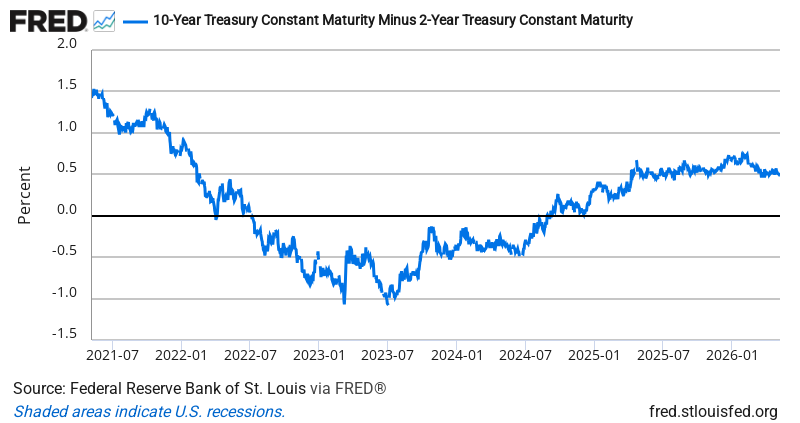
The 10-year minus 2-year Treasury spread held steady at 0.49% this week, marking its most stable stretch since the energy crisis began. After months of wild swings driven by oil-shock inflation fears, the yield curve is finding its footing in positive territory — a welcome sign that recession signals are cooling off.
This matters more than the flat reading suggests. The Treasury market is essentially saying: yes, we have an energy crisis with oil at $95, but no, we don’t think it’s tipping the economy into recession. The spread has drifted down from 0.52% at month-end but remains comfortably above zero — the key threshold where recession warnings typically flash red. Historically, yield curve inversions (when short rates exceed long rates) have preceded every recession since the 1970s. Right now, that signal is quiet.
The stability reflects a market recalibrating to a new reality: higher energy costs are inflationary, not recessionary, for a net energy exporter like the US. The Fed has shelved rate cuts, which keeps short-term yields elevated, but longer-term bonds aren’t pricing in economic collapse. Instead, we’re seeing the classic pattern of an economy absorbing a supply shock — some inflation pressure, but underlying growth holding up.
Many professional investors view this type of environment as favoring assets that can pass through higher costs. Historically, periods of supply-driven inflation have led investors to look at energy producers, value stocks, and companies with strong pricing power over rate-sensitive growth names and long-duration bonds.
Bottom Line: A steady yield curve in the middle of an energy crisis is actually good news — it suggests the market thinks we can handle $95 oil without falling into recession. The question now is whether this calm holds if energy prices climb higher.
Source: Federal Reserve Economic Data (FRED)
ON1010.com provides economic education for investors. Nothing here is investment advice. Always consult a qualified financial advisor before making investment decisions.
Free Research
The economy moves fast. We make sure you move faster.
Economic data, policy shifts, and market signals — delivered to your inbox.
Subscribe Free