
Treasuries Rise as Oil Shock Keeps Fed on Pause
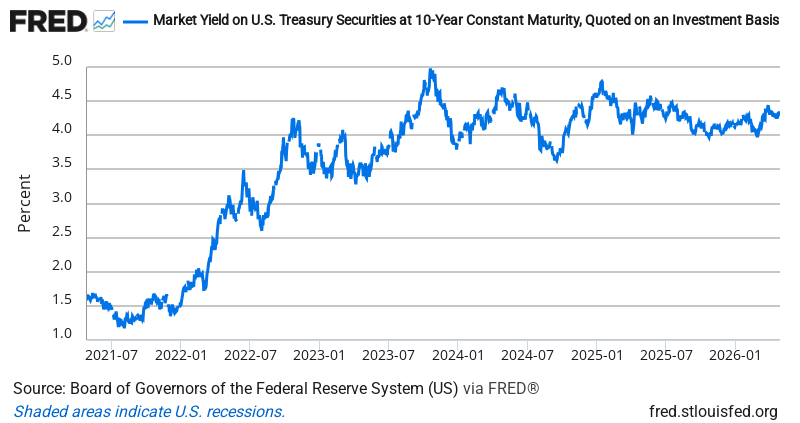
Bond yields climbed to 4.35% Monday, up from 4.31% on Thursday, as the 10-year Treasury continues its volatile dance around energy-driven inflation fears. The move higher reflects investors pricing in a Fed that’s stuck on the sidelines while oil trades near $95 — nearly 45% above pre-crisis levels.
This isn’t your typical rate environment. With the Strait of Hormuz closed since February 28 following US-Israel strikes on Iran, energy inflation has forced the Fed to shelve rate cuts entirely. Every sustained $10 premium on oil adds roughly 0.6% to CPI, meaning monthly inflation readings could soon print with a 1-handle. That’s pushed the 10-year into a choppy 4.26% to 4.35% range as bond investors wrestle with conflicting signals: solid economic fundamentals versus an oil shock that’s reshaping the entire rate outlook.
The math is brutal for fixed income. Pre-crisis, CPI and PCE were settling nicely at 2.5% annually. Now, with crude at $95 versus the $66 baseline, inflation expectations are spiking faster than central bankers can manage. Higher-for-longer is back, and bond prices are adjusting accordingly.
Many professional investors are reconsidering duration risk in this environment. When energy shocks drive inflation, shorter-term bonds typically outperform longer-dated paper. Historically, this type of supply-driven inflation spike has led investors to favor floating-rate assets and sectors that can pass through higher costs — energy producers, commodity plays, and companies with strong pricing power.
Bottom Line: The 10-year is pricing in a Fed that’s lost control of the inflation narrative, at least temporarily. Until the Strait reopens or strategic reserves meaningfully cool oil prices, expect Treasury volatility to remain elevated as investors navigate an economy caught between solid fundamentals and an energy crisis that changes everything.
Source: Federal Reserve Economic Data (FRED)
ON1010.com provides economic education for investors. Nothing here is investment advice. Always consult a qualified financial advisor before making investment decisions.
Free Research
The economy moves fast. We make sure you move faster.
Economic data, policy shifts, and market signals — delivered to your inbox.
Subscribe Free