
Treasury Curve Flattens as Energy Shock Reshapes Fed Outlook
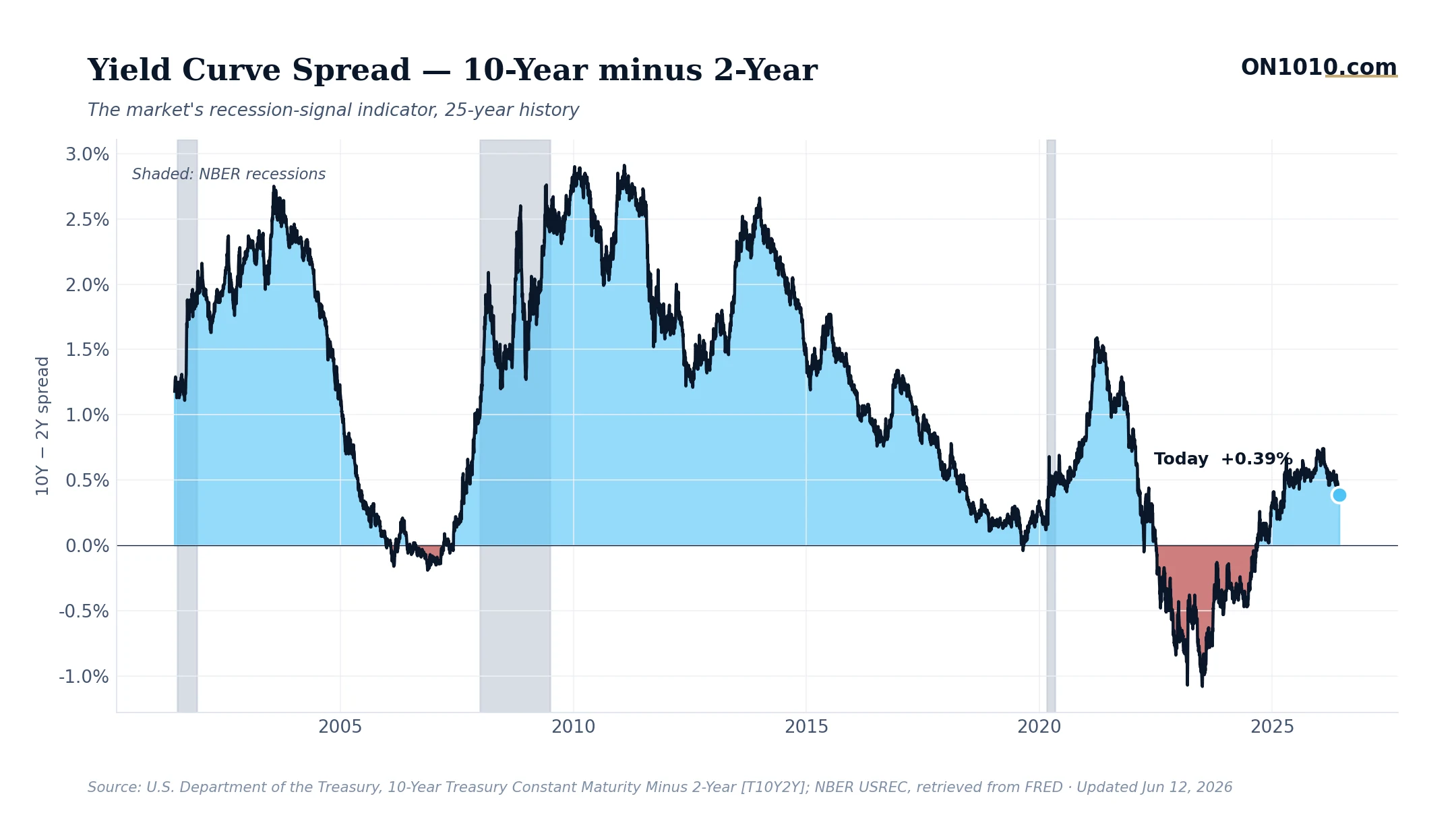
The 10-year minus 2-year Treasury spread slipped to 0.39% yesterday, down from 0.40% a day earlier and marking its narrowest level since June 5th. That’s still positive territory, far from the inversion that has historically preceded recessions, but the steady compression tells a bigger story about where markets think the economy is heading.
The flattening reflects two competing forces: short-term rates staying elevated as the Fed holds the line against energy-driven inflation, while longer-term yields moderate on growth concerns. With WTI crude near $95 following the Strait of Hormuz closure, every 10% oil premium historically adds about 0.6% to consumer prices. That’s kept rate cut expectations off the table and anchored the front end of the curve higher than many expected just months ago.
Here’s the twist: this isn’t your typical recession setup. The US is a net energy exporter, so higher oil prices create winners (domestic producers) alongside losers (consumers). The curve isn’t inverting because markets expect a classic demand collapse. Instead, it’s flattening because investors see an economy caught between energy-driven inflation in the near term and slower growth as higher prices work through the system.
Historically, this type of shallow, gradual flattening has preceded periods of economic moderation rather than sharp contractions. In past cycles, investors have watched for the spread to approach zero as a more serious warning signal, while readings above 0.30% have typically coincided with continued, if slower, expansion.
Bottom Line: At 0.39%, the curve is telling a story of cooling growth, not imminent recession, but the margin for error is narrowing as energy costs reshape the Fed’s calculus.
Source: Federal Reserve Economic Data (FRED)
ON1010 Research is an independent publisher of economic education and is not a registered investment adviser, broker-dealer, or investment company. This content is for educational and informational purposes only and is not investment advice or a recommendation to buy, sell, or hold any security. Published under the publisher exemption recognized by Section 202(a)(11)(D) of the Investment Advisers Act of 1940 (Lowe v. SEC). Always consult a qualified financial professional before making any financial decision.
Free Research
The economy moves fast. We make sure you move faster.
Economic data, policy shifts, and market signals — delivered to your inbox.
Subscribe Free