
Treasury Yield Curve Hangs in the Balance as Oil Shock Tests Recovery
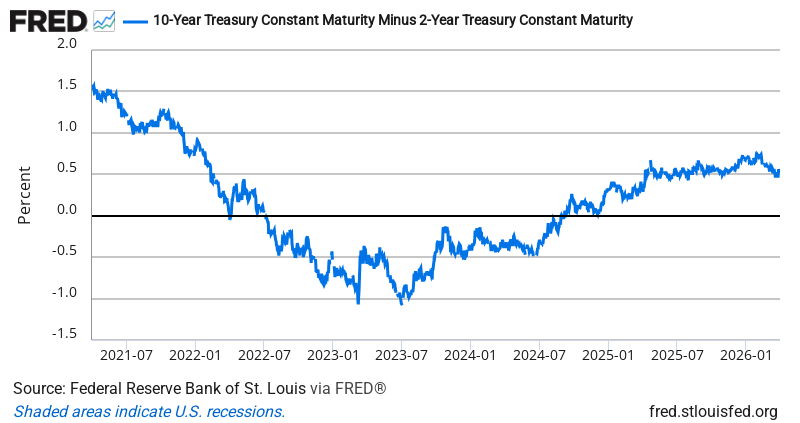
The gap between 10-year and 2-year Treasury yields has narrowed to just 0.51%, down from 0.53% yesterday — putting one of the market’s most watched recession indicators back in focus. While still positive, this spread has compressed sharply over the past week, falling from 0.56% on March 27th as oil-driven inflation fears clash with growth concerns.
Here’s the tension: the yield curve is caught between two opposing forces. Higher oil prices (WTI now near $95 after the Strait of Hormuz closure) are pushing up long-term inflation expectations, which should steepen the curve. But they’re also raising recession fears as energy costs squeeze consumers and businesses. When recession risk rises, investors pile into long-term bonds, flattening the curve. Right now, the recession trade is winning — barely.
This matters because yield curve inversions have preceded every recession since 1969, typically by 6-22 months. We’re not inverted yet, but we’re uncomfortably close. The current 0.51% spread means just 51 basis points separate us from that warning signal. Meanwhile, the Fed has already paused rate cuts due to energy-driven inflation, removing a key support for the curve’s steepness.
Many professional investors view a narrowing yield curve as a yellow light for risk assets, particularly when it’s driven by growth concerns rather than Fed policy. Historically, this environment has led investors to reduce duration risk in bond portfolios and consider defensive equity sectors — utilities have outperformed the S&P 500 by 4.5% recently, a classic curve-flattening trade.
Bottom Line: The yield curve is telling us the oil shock’s growth impact may be overtaking its inflation impact. If this spread drops much further, recession positioning could accelerate quickly.
Source: Federal Reserve Economic Data (FRED)
ON1010.com provides economic education for investors. Nothing here is investment advice. Always consult a qualified financial advisor before making investment decisions.
Free Research
The economy moves fast. We make sure you move faster.
Economic data, policy shifts, and market signals — delivered to your inbox.
Subscribe Free