
Treasury Yields Drop as Bond Market Questions the Durability of Recent Rate Spike
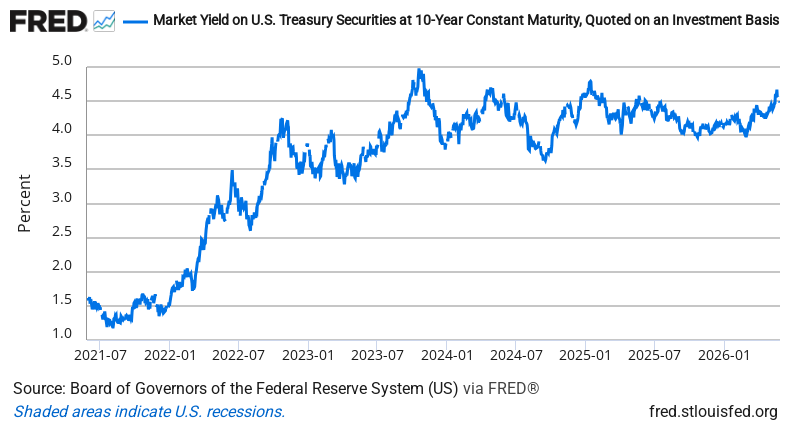
The 10-year Treasury yield fell to 4.48% yesterday, down from 4.50% Monday and continuing a pullback from last week’s peak of 4.67%. That’s a 19 basis point decline in just five trading days — meaningful movement for a market that often moves in single digits.
Here’s what’s interesting: this isn’t panic buying. It’s more like bond traders taking a step back and asking whether the recent spike above 4.6% was an overreaction. Remember, yields had been grinding higher for weeks on expectations of persistent inflation and continued Fed hawkishness. But when yields hit those levels, something shifted. Maybe it was profit-taking, maybe it was a realization that 4.6%+ yields were pricing in more rate hikes than the economy can actually handle. The bond market has a way of self-correcting when yields get ahead of fundamentals.
The decline matters because Treasury yields are the economy’s discount rate — they determine how investors value everything from mortgage payments to corporate cash flows. When the 10-year drops 19 basis points in a week, it’s like giving a small stimulus to asset prices across the board. Real estate looks a bit more attractive, growth stocks get a modest tailwind, and corporate borrowing costs ease slightly.
For portfolios, this type of yield volatility often signals a market in search of direction. Many professional investors use periods like this to reassess duration risk — the sensitivity of their bond holdings to interest rate changes. Historically, when yields are bouncing around the 4.5% level, it suggests the market is trying to find fair value in an uncertain environment.
Bottom Line: Bond traders are second-guessing whether yields above 4.6% made sense. If they’re right, we could see more relief across rate-sensitive assets. If they’re wrong, this pullback is just a pause before the next leg higher.
Source: Federal Reserve Economic Data (FRED)
ON1010.com provides economic education for investors. Nothing here is investment advice. Always consult a qualified financial advisor before making investment decisions.
Free Research
The economy moves fast. We make sure you move faster.
Economic data, policy shifts, and market signals — delivered to your inbox.
Subscribe Free