
Treasury Yields Hold Steady as Bond Market Finds Its Floor
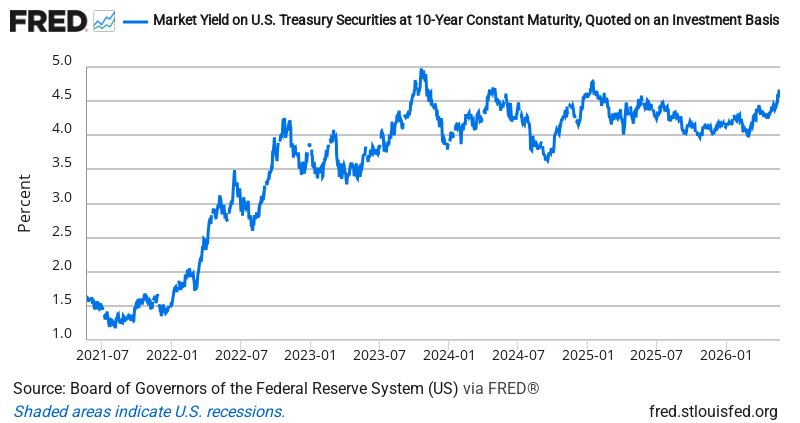
The 10-year Treasury yield sat unchanged at 4.57% on Wednesday, marking two days of stability after a volatile week that saw rates swing from 4.47% to 4.67%. When the bond market’s benchmark stops moving, it usually means investors are digesting something big.
This plateau around 4.6% is telling us something important: the bond market may have found its new equilibrium for now. After months of uncertainty about Fed policy and inflation expectations, yields appear to be settling into a range that reflects current economic reality — neither the ultra-low rates of the pandemic era nor the panic spikes we’ve seen during inflation scares. The recent volatility followed by this sudden calm suggests institutional investors are done repositioning and are now waiting for the next major data release to guide their next move.
Historically, when 10-year yields stabilize in the mid-4% range after a period of volatility, it creates interesting opportunities across asset classes. Many professional investors view this environment as a “Goldilocks” scenario for diversified portfolios — yields high enough to make bonds attractive again after years of near-zero returns, but not so high that they crush corporate borrowing or tank stock valuations. In this type of environment, investors often look more closely at dividend-paying stocks that can compete with bond yields, and high-quality corporate bonds that benefit from the higher base rate.
Bottom Line: When the bond market goes quiet after a noisy week, it’s usually building energy for the next move. The question isn’t whether rates will move again — it’s what will trigger that move.
Source: Federal Reserve Economic Data (FRED)
ON1010.com provides economic education for investors. Nothing here is investment advice. Always consult a qualified financial advisor before making investment decisions.
Free Research
The economy moves fast. We make sure you move faster.
Economic data, policy shifts, and market signals — delivered to your inbox.
Subscribe Free