
Yield Curve Continues Its Fragile Recovery From Inversion
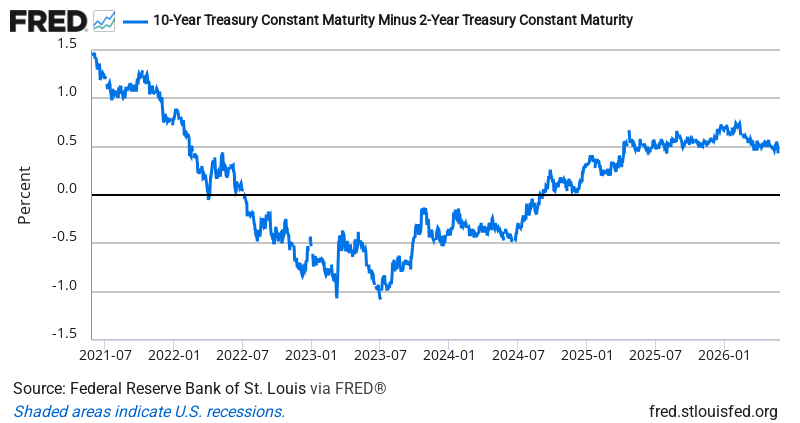
The gap between 10-year and 2-year Treasury yields ticked down to 0.48% yesterday, a modest decline from 0.49% the day before. While that’s a tiny move, the bigger story is where we are: the yield curve has been gradually steepening since emerging from inversion earlier this year, but progress remains choppy and uncertain.
This matters because yield curve inversions have predicted every recession since the 1960s — when short-term rates climb above long-term rates, it signals the Fed has tightened policy so much that growth is at risk. The fact that we’re now in positive territory suggests recession risk may be receding, but the curve’s fragile recovery reflects ongoing uncertainty about Fed policy and inflation. The energy shock from the Strait of Hormuz closure has complicated the picture, making it harder for the Fed to cut rates as markets had expected earlier this year.
The current reading of 0.48% puts us in a transitional zone. Historically, when the curve re-steepens after inversion, it often signals either the start of Fed easing (bullish for risk assets) or the beginning of a recession (when long-term rates fall faster than short-term rates). The energy crisis has kept the Fed on hold, which means this steepening likely reflects growth expectations rather than policy easing — a more sustainable foundation for markets.
Many professional investors view a sustainably positive yield curve as a green light for duration risk and growth assets. Historically, periods when the curve moves from flat to modestly steep have favored sectors that benefit from easier financial conditions — particularly smaller companies and interest-sensitive plays like REITs.
Bottom Line: The yield curve is healing, but slowly. A sustained move above 0.5% would signal we’re truly past the inversion danger zone — something worth watching as energy markets stabilize.
Source: Federal Reserve Economic Data (FRED)
ON1010.com provides economic education for investors. Nothing here is investment advice. Always consult a qualified financial advisor before making investment decisions.
Free Research
The economy moves fast. We make sure you move faster.
Economic data, policy shifts, and market signals — delivered to your inbox.
Subscribe Free