
Yield Curve Flattens as Bond Market Stays Cautious
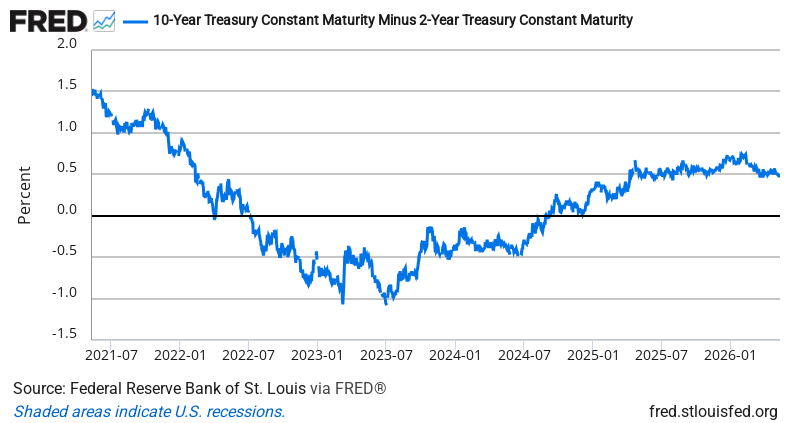
The 10-year minus 2-year Treasury spread narrowed to 0.47% Friday, down from 0.48% earlier in the week. While still in positive territory, the curve continues its gradual flattening trend that started in early May — a sign bond investors remain wary about the economic outlook despite strong equity performance.
This flattening reflects a classic investor dilemma: long-term rates aren’t rising as fast as short-term rates, suggesting the market isn’t fully buying into the growth narrative driving stocks higher. With the Fed on pause due to energy-driven inflation concerns and oil trading near $95 following the Strait of Hormuz crisis, bond traders are pricing in a “higher for longer” rate environment without the growth acceleration that would typically push long-term yields up faster.
The spread has compressed by about 6 basis points over the past week, even as the S&P 500 continues marching higher above both its 50-day and 200-day moving averages. This divergence is worth watching — when bonds and stocks tell different stories, bonds often prove prescient about economic turning points.
Many professional investors view a flattening curve as a yellow flag for credit-sensitive investments and cyclical sectors, while defensive positioning becomes more attractive. Historically, periods of curve flattening have led investors to favor shorter-duration bonds, dividend-paying stocks, and sectors less dependent on economic acceleration.
Bottom Line: The bond market’s caution stands in stark contrast to equity optimism — a divergence that rarely lasts long. Which market is reading the economic tea leaves correctly may become clearer as energy prices and Fed policy evolve.
Source: Federal Reserve Economic Data (FRED)
ON1010.com provides economic education for investors. Nothing here is investment advice. Always consult a qualified financial advisor before making investment decisions.
Free Research
The economy moves fast. We make sure you move faster.
Economic data, policy shifts, and market signals — delivered to your inbox.
Subscribe Free