
The 10-Year Yield Just Crossed 5%. Here’s Why That Number Has a History.
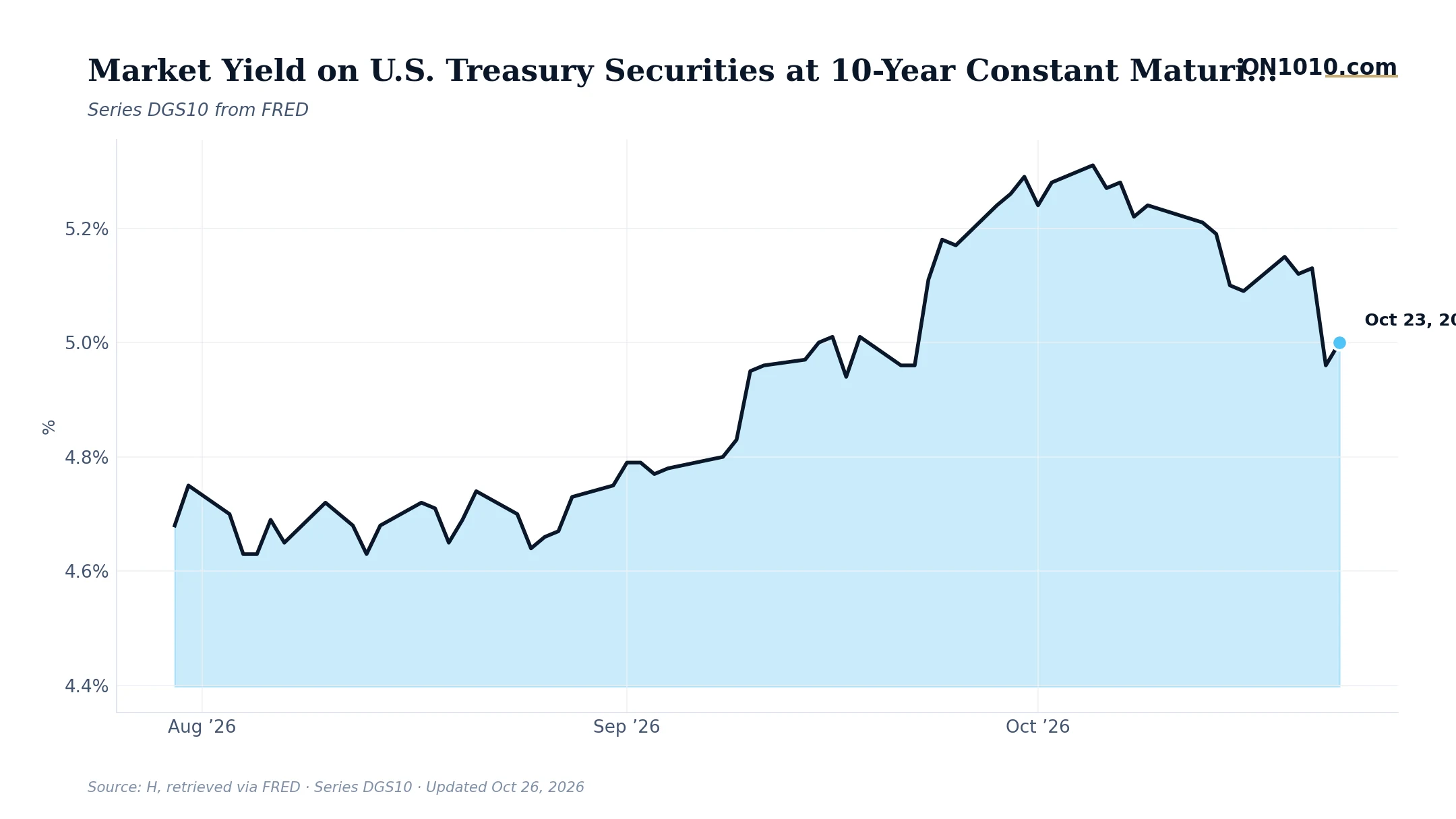
The 10-year Treasury yield hit exactly 5.0% on October 23, ticking up 0.04 points from the prior session. The round number is psychologically significant, but the real story is the range it’s been holding: between 5.09% and 5.15% for most of the past week before dipping briefly, then returning to this threshold.
Markets are sending a consistent message. Defensive sectors are outperforming offensive ones by more than 9 percentage points over the past month. Utilities and consumer staples are leading while technology and communication services lag badly. When institutional money rotates like that alongside a stubborn 5% long-rate environment, the bond market and equity market are telling the same story, just in different languages.
The broader setup is uncomfortable. Monetary policy is restrictive by historical standards. Core inflation remains elevated. Credit spreads are wide and rising, meaning the bond market’s stress gauge is flashing something beyond just the Treasury yield level. Consumer sentiment sits near the bottom of its historical range. These indicators rarely all point in the same direction, but right now they do.
Historically, when long-term rates have held at levels this high relative to their own history, a recession has begun within the following 12 months about 20% of the time. That is one-in-five odds, not a coin flip, but not a certainty either. In past cycles, borrowing costs at this level have compressed corporate margins by raising the cost of refinancing debt, and dampened capital investment plans as hurdle rates for new projects rise. Business operators thinking about long-term financing decisions or capital commitments will want to think carefully about those dynamics with a qualified financial professional who knows their specific situation.
Bottom Line: At 5%, the 10-year yield is squeezing the economy from multiple directions at once. The question worth asking is whether inflation falls fast enough to give the Fed room to ease before that pressure accumulates into something more serious.
Source: Federal Reserve Economic Data (FRED)
ON1010 Research is an independent publisher of economic education and is not a registered investment adviser, broker-dealer, or investment company. This content is for educational and informational purposes only and is not investment advice or a recommendation to buy, sell, or hold any security. Published under the publisher exemption recognized by Section 202(a)(11)(D) of the Investment Advisers Act of 1940 (Lowe v. SEC). Always consult a qualified financial professional before making any financial decision.
Free Research
The economy moves fast. We make sure you move faster.
Economic data, policy shifts, and market signals — delivered to your inbox.
Subscribe Free