
The 2-Year Yield Bounced. The Bond Market Is Still Nervous.
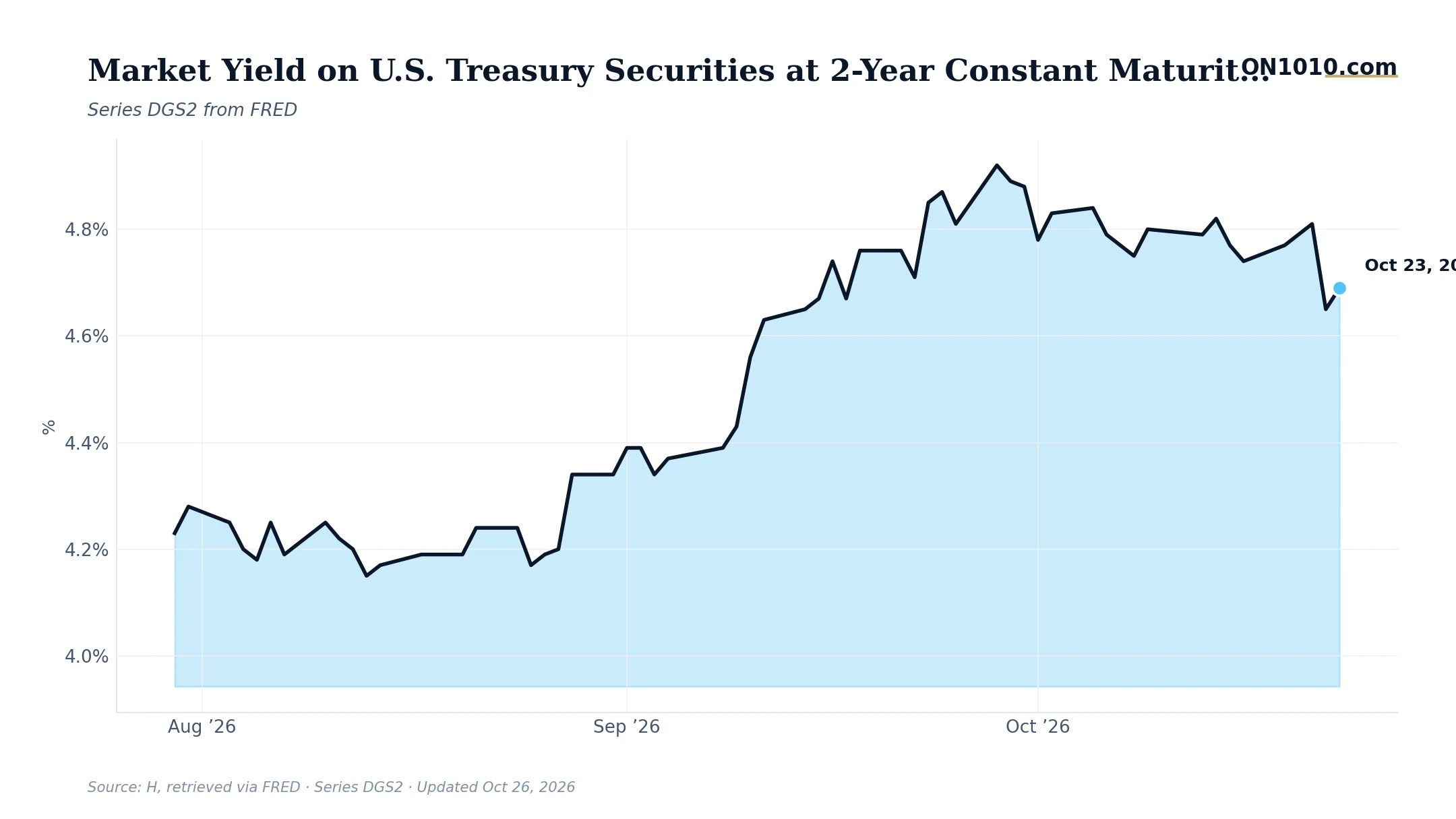
The 2-year Treasury yield ticked up to 4.69% on Friday, recovering from a sharp mid-week dip that briefly pulled it down to 4.65%. Small move on the surface. But zoom out to the past week and you see something more interesting: the 2-year swung from 4.81% to 4.65% and back, a 16-basis-point round trip in five trading days.
Bond markets don’t usually move like that without a reason.
The 2-year yield is essentially the bond market’s best guess at where the Fed funds rate will average over the next couple of years. When it shoots up, markets are pricing out cuts. When it drops, they’re pricing them back in. That kind of volatility within a single week suggests investors are genuinely uncertain about the Fed’s next move, and the current backdrop makes that uncertainty rational. Inflation is running hot relative to history. The real policy rate (what the Fed charges above inflation) sits above its historical midpoint and is still rising. Credit spreads are wide. Consumer sentiment is near its lowest historical readings. These indicators aren’t all pointing the same direction.
Historically, when short-term rates have sat at these levels alongside tightening credit conditions and a restrictive real policy rate, the pressure on business borrowing costs has been real. In past cycles, operators running floating-rate debt or planning near-term refinancing have felt this acutely, because the cost of capital doesn’t just follow the Fed’s stated rate, it tracks where the 2-year is heading. Business leaders allocating capital or managing debt structures have used this yield as a rough proxy for how long the Fed intends to stay tight. Past episodes of sustained elevated short-term rates have historically been followed by softer business investment and tightening lending standards, though the timing has varied considerably. A qualified financial professional is the right resource for applying any of this to specific financing decisions.
Bottom Line: The 2-year yield’s mid-week drop and quick reversal tells you the market is not settled on the Fed’s path. With monetary policy already restrictive by historical standards and credit stress building, the question worth tracking is whether the next meaningful move in this yield is down because the Fed finally cuts, or up because inflation forces them to hold longer than anyone expects.
Source: Federal Reserve Economic Data (FRED)
ON1010 Research is an independent publisher of economic education and is not a registered investment adviser, broker-dealer, or investment company. This content is for educational and informational purposes only and is not investment advice or a recommendation to buy, sell, or hold any security. Published under the publisher exemption recognized by Section 202(a)(11)(D) of the Investment Advisers Act of 1940 (Lowe v. SEC). Always consult a qualified financial professional before making any financial decision.
Free Research
The economy moves fast. We make sure you move faster.
Economic data, policy shifts, and market signals — delivered to your inbox.
Subscribe Free