
Consumer Confidence Just Hit a Level That Usually Precedes a Rebound. But Something Feels Different This Time.
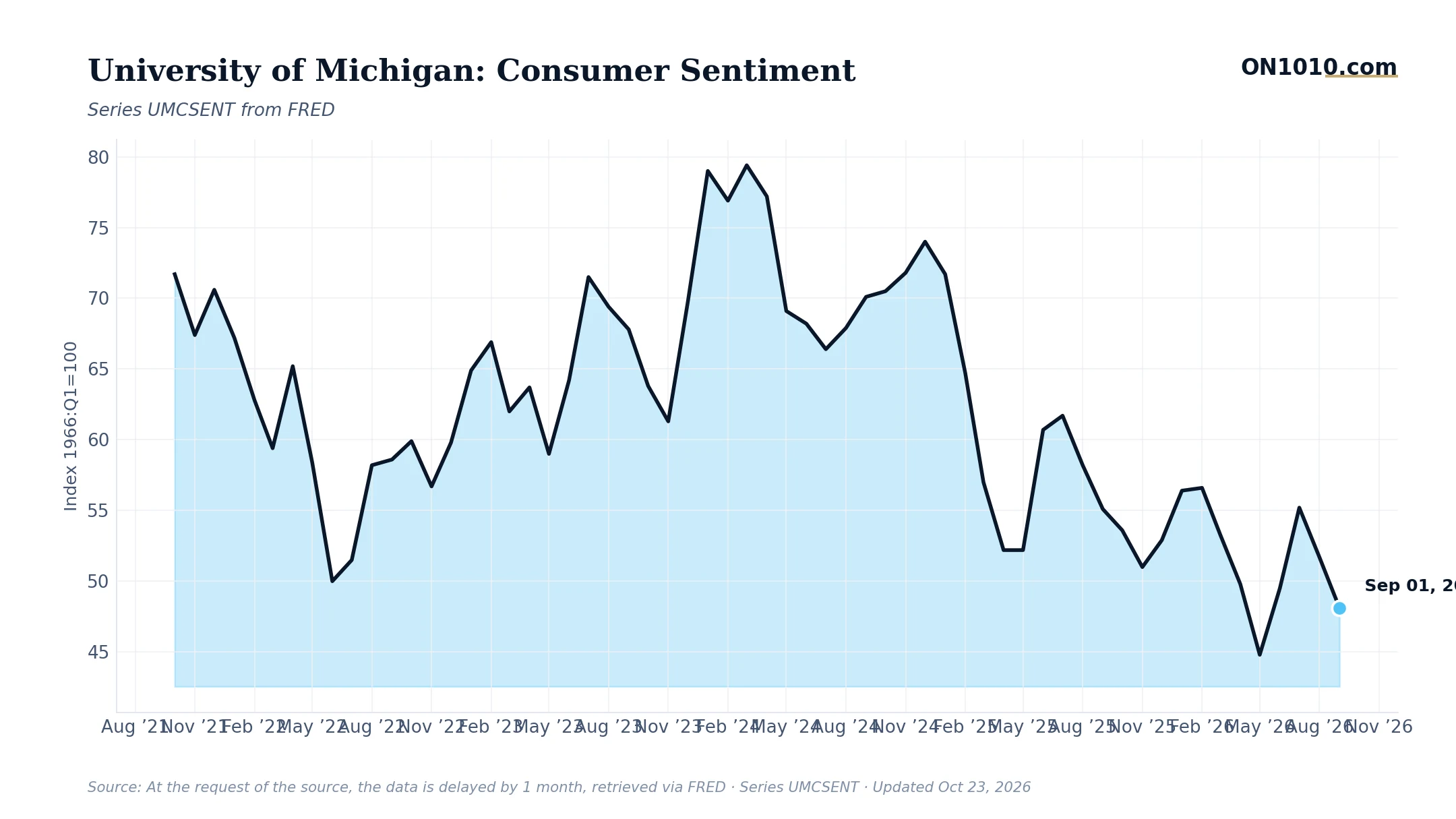
The University of Michigan’s Consumer Sentiment index fell to 48.1 in September, down 3.6 points from August’s 51.7. That’s a drop of nearly 7% in a single month, and it pushes sentiment back toward the lows hit in May (44.8) after a brief summer recovery that now looks like it’s fading fast.
Here’s what makes this reading worth examining closely. Sentiment has been bouncing in a tight, depressed range since April, between roughly 45 and 55, rather than building any sustained recovery. The summer lift from May to July raised hopes that the worst was behind us. September’s reversal suggests the pessimism isn’t clearing, just oscillating. Consumers got a little more hopeful. Then they didn’t.
The backdrop matters here. Monetary policy is running restrictive by historical standards, long-term interest rates are elevated, and credit spreads remain wide. All three of those conditions squeeze household budgets and darken the economic outlook for ordinary people. The economy is asking consumers to pay more to borrow, more to carry debt, and more in real terms if inflation stays above wage growth. Under those conditions, pessimism makes sense. What’s notable is where sentiment sits historically: near the very bottom of its long-run range. Historically, when readings have been this depressed, a recession did not follow within the next 12 months. And a year later, sentiment typically drifted higher. Past performance doesn’t predict future results, but the base rate is worth knowing.
The complication is that market signals are telling a different story than the historical base rate would suggest. Defensive sectors have sharply outperformed offensive ones over the past month, with consumer staples and utilities showing particular strength relative to the broader market. Historically, that kind of rotation reflects institutional investors repositioning ahead of perceived economic softness, and it lines up with what consumers are saying in Michigan’s survey.
For business decision makers, in past cycles, when sentiment stayed this low for an extended stretch, companies that relied on discretionary consumer spending often found demand growth harder to sustain than headline GDP suggested. The aggregates can look okay while the underlying consumer is under real pressure. Whether this reading proves a floor or a stepping stone lower depends heavily on what happens to rates and the employment picture over the next few months.
Bottom Line: Consumer sentiment has now been weak for most of 2026, and the summer’s brief recovery has given back significant ground. The question is whether this is exhausted pessimism approaching a turning point, or a signal that the consumer is genuinely starting to pull back in ways that will show up in spending data.
Source: Federal Reserve Economic Data (FRED)
ON1010 Research is an independent publisher of economic education and is not a registered investment adviser, broker-dealer, or investment company. This content is for educational and informational purposes only and is not investment advice or a recommendation to buy, sell, or hold any security. Published under the publisher exemption recognized by Section 202(a)(11)(D) of the Investment Advisers Act of 1940 (Lowe v. SEC). Always consult a qualified financial professional before making any financial decision.
Free Research
The economy moves fast. We make sure you move faster.
Economic data, policy shifts, and market signals — delivered to your inbox.
Subscribe Free