
The Yield Curve Is No Longer Screaming. That’s the Complicated Part.
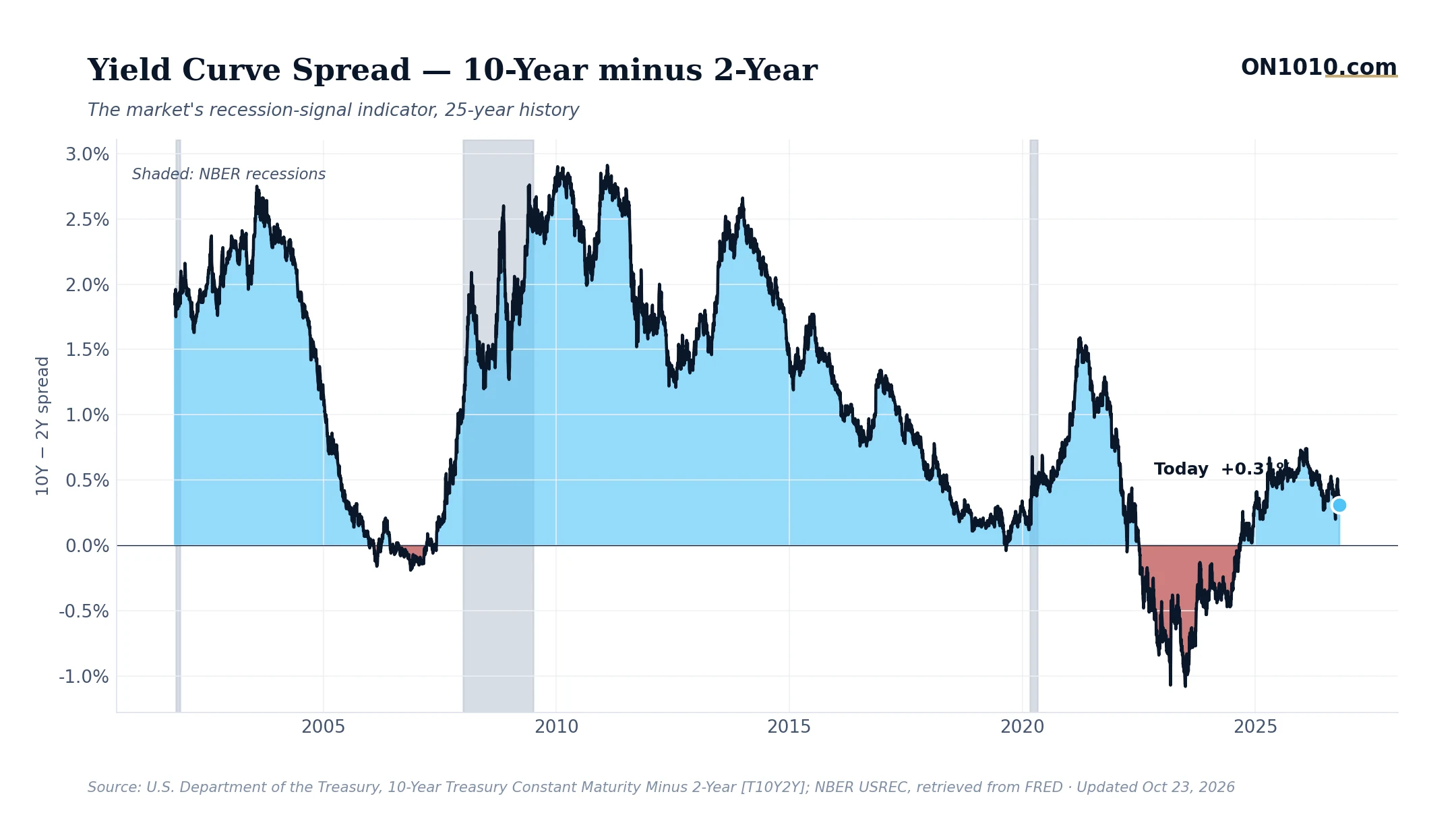
The 10-year/2-year Treasury spread has been sitting at 0.31% for two days running, holding in positive territory after one of the most severe and prolonged yield curve inversions in modern history. The curve is no longer inverted. That sounds like good news. History says it deserves a closer look.
Here’s what makes this reading genuinely interesting: the spread peaked at 0.38% just four days ago before easing back to 0.31%. It has stabilized, but it hasn’t widened. In an environment where long-term rates are historically elevated and still rising, that stability reflects a bond market caught between competing forces, a restrictive Fed, sticky inflation still running hot by historical standards, and an economy that, by growth metrics, remains close to its long-run average.
The bigger picture adds texture. Credit spreads are wide relative to history, which signals that lenders are demanding more compensation for the risk of lending to businesses. Consumer sentiment sits near the bottom of its historical range. Defensive sectors, consumer staples, utilities, health care, have outpaced the broad market by nearly nine percentage points over the past month, with technology down sharply on a relative basis. Markets reprice before economists revise. When money rotates this decisively toward safety, the bond market’s message is worth taking seriously.
The historical pattern here is specific and worth knowing. Historically, it’s the re-steepening of the yield curve after a deep inversion, not the inversion itself, that has often coincided with recession onset or its early months. The curve inverts as the Fed tightens, then snaps back as rate cuts get priced in and short-term yields fall. Depending on which force drives the steepening, long rates rising, short rates falling, or both, the economic signal can mean very different things. In past cycles, business decision-makers and capital allocators have paid close attention to what’s driving the shape, not just the shape itself.
Bottom Line: A positive yield curve reading after a historic inversion looks like a return to normal. The question is whether this spread is widening because the economy is strengthening, or because long-term rates are rising faster than short-term ones, and those two stories have very different endings.
Source: Federal Reserve Economic Data (FRED)
ON1010 Research is an independent publisher of economic education and is not a registered investment adviser, broker-dealer, or investment company. This content is for educational and informational purposes only and is not investment advice or a recommendation to buy, sell, or hold any security. Published under the publisher exemption recognized by Section 202(a)(11)(D) of the Investment Advisers Act of 1940 (Lowe v. SEC). Always consult a qualified financial professional before making any financial decision.
Free Research
The economy moves fast. We make sure you move faster.
Economic data, policy shifts, and market signals — delivered to your inbox.
Subscribe Free