
The Yield Curve Just Flashed Its Most Positive Reading in Weeks. Here’s What That Actually Means.
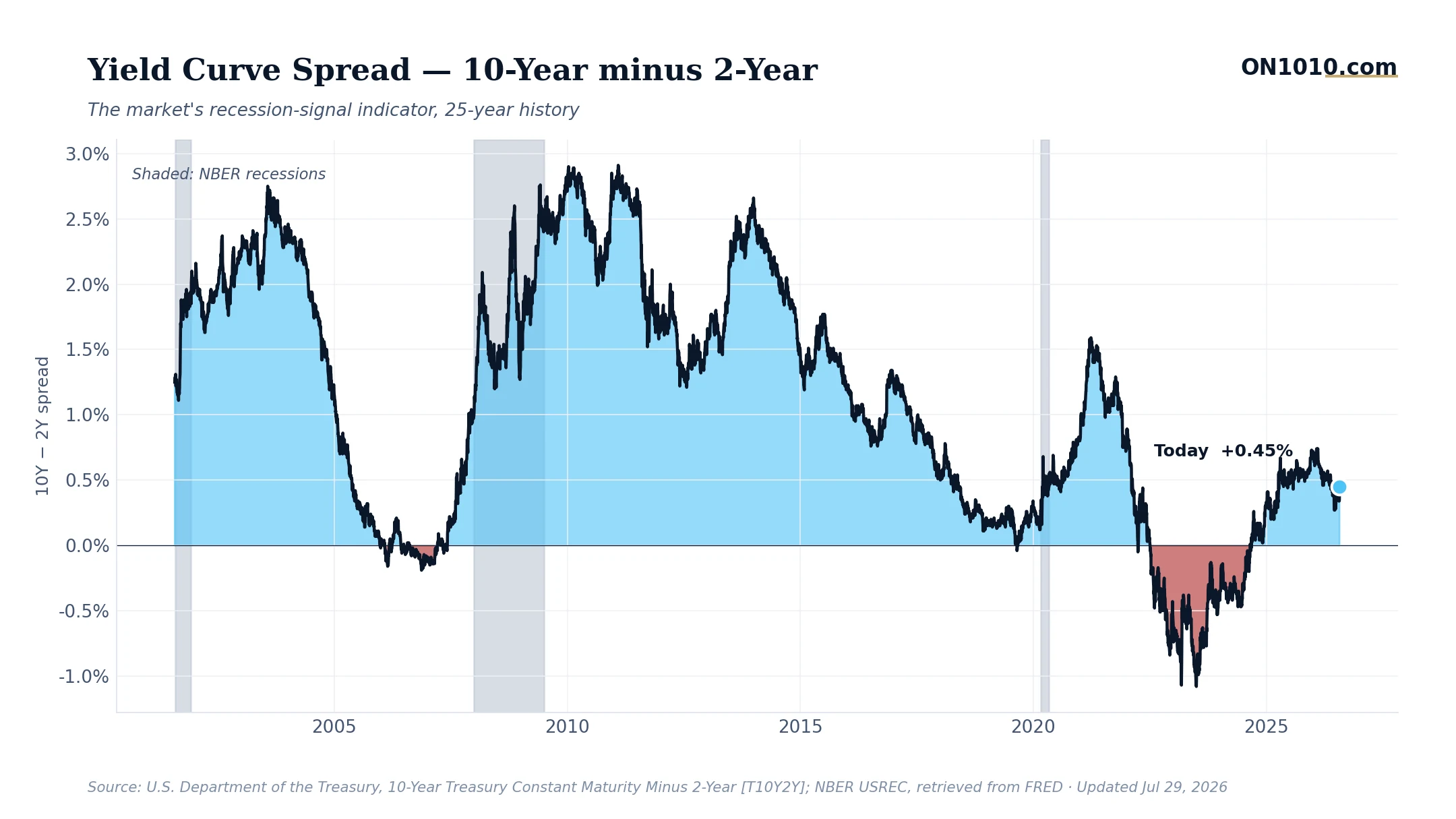
The gap between 10-year and 2-year Treasury yields widened to 0.45% on July 29, up from 0.35% the day before. That single-day jump of 0.10 percentage points is meaningful because this particular spread is one of the most closely watched signals in all of macro, and it just hit its widest positive reading in recent weeks.
The Bigger Picture
The yield curve was deeply inverted for much of 2023 and 2024, a historic stretch that had many economists calling for recession. That recession never arrived on schedule, which is a reminder about treating any single indicator as a crystal ball. Now, with the spread back in positive territory and trending wider, the curve is telling a more constructive story: long-term investors are demanding a modest premium above short-term rates again, which reflects some confidence that growth continues without an immediate rate collapse.
That said, the broader backdrop is complicated. Long-term rates are sitting at the 72nd percentile of their historical range, meaning conditions remain tighter than normal for businesses financing equipment, real estate, or expansion. And consumer sentiment is at its weakest reading in the entire historical record, sitting at the 0th percentile. Credit spreads are tight, meaning corporate borrowers aren’t being punished yet, but the mood of actual consumers and the cost of long-term debt are pulling in opposite directions.
Why It Matters
Historically, when the curve re-steepens after a prolonged inversion, it has marked the transition between two very different economic environments. In past cycles, business owners and capital allocators have watched this shift carefully because borrowing cost structures change, bank lending margins improve, and the incentive to deploy longer-duration capital can shift meaningfully. The base rate worth knowing: from today’s interest rate zone, a recession began within the following 12 months about 18% of the time. Not alarming, but not zero.
Bottom Line: The yield curve moving positive is a constructive signal, but one indicator sitting inside a dashboard full of mixed readings. The real question is whether a widening spread reflects genuine growth confidence or just the bond market repositioning ahead of a Fed that hasn’t finished its work yet.
Source: Federal Reserve Economic Data (FRED)
ON1010 Research is an independent publisher of economic education and is not a registered investment adviser, broker-dealer, or investment company. This content is for educational and informational purposes only and is not investment advice or a recommendation to buy, sell, or hold any security. Published under the publisher exemption recognized by Section 202(a)(11)(D) of the Investment Advisers Act of 1940 (Lowe v. SEC). Always consult a qualified financial professional before making any financial decision.
Free Research
The economy moves fast. We make sure you move faster.
Economic data, policy shifts, and market signals — delivered to your inbox.
Subscribe Free