
The Fed Holds at 3.5%: What Staying Put Actually Means Right Now
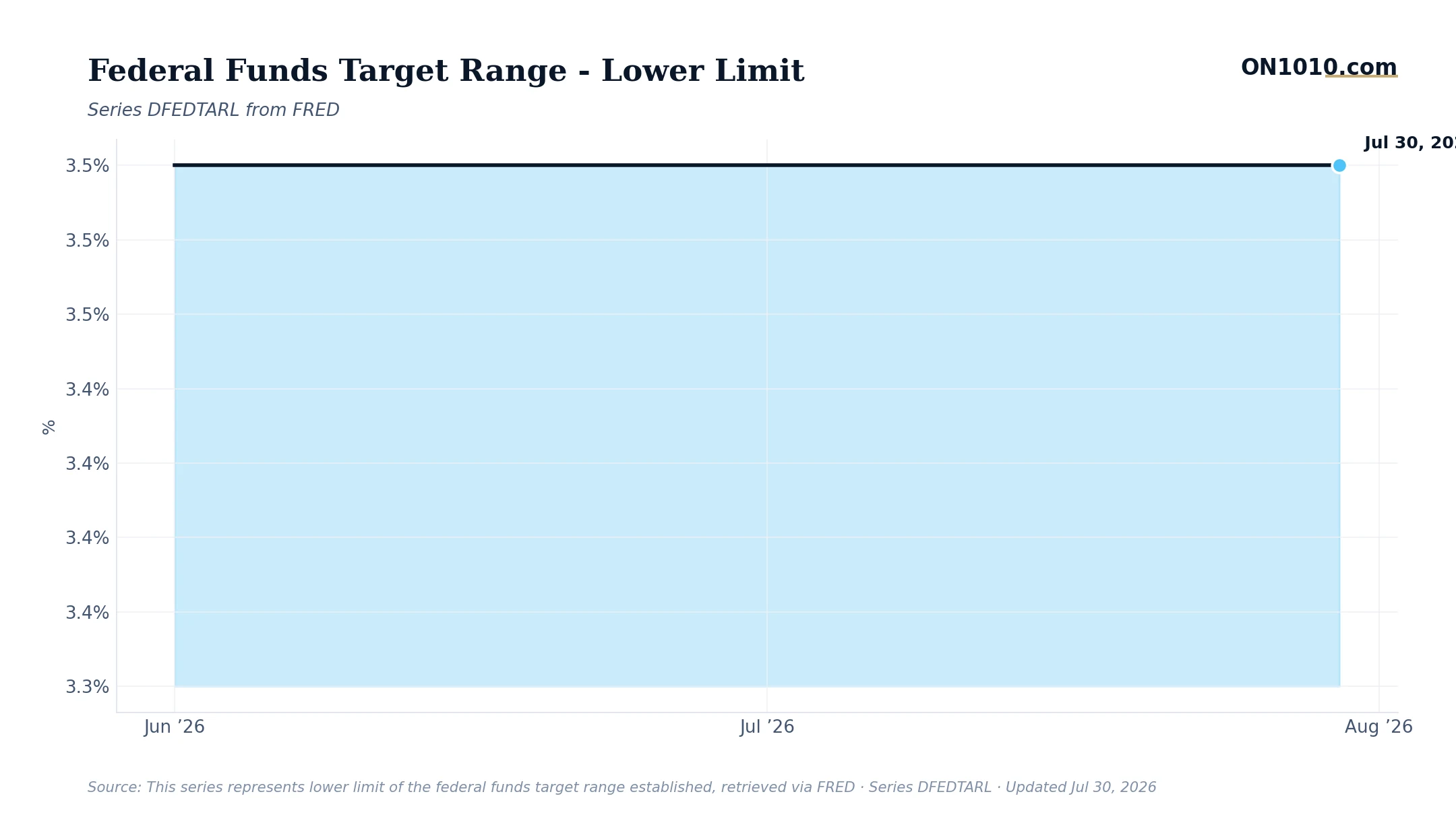
The federal funds rate target sits at 3.5%, unchanged, and that steadiness is doing more work than it looks like on the surface.
The Fed hasn’t moved this rate since it was cut to this level. But holding rates steady is never a neutral act. It’s an active choice, and right now that choice is being made inside a genuinely unusual mix of conditions: inflation sitting at the 92nd percentile of its historical range and still rising, while consumer sentiment has collapsed to its lowest reading on record, and credit spreads remain remarkably tight.
That combination is the tension worth understanding. Hot inflation argues for keeping rates elevated or pushing them higher. Crushed consumer confidence argues for cutting. The Fed is threading a needle between those two pressures, and 3.5% is where it has chosen to stand.
Here’s the bigger picture: our monetary policy gauge sits at the 56th percentile of history, roughly neutral. Rates haven’t been cut deep enough to be stimulative, but they’re no longer in the kind of restrictive territory that characterized 2023 and early 2024. The economy is essentially running at the Fed’s speed limit, not being pushed hard in either direction. Long-term interest rates are still high by historical standards (71st percentile), meaning the real economy, mortgages, business loans, refinancing decisions, is still feeling genuine cost pressure even as the policy rate holds.
Historically, when monetary policy has been in this middle range, a recession has followed within 12 months about 11% of the time. That’s real risk worth acknowledging, but it’s also roughly 9-in-10 odds the other way. Worth knowing, not worth catastrophizing.
For businesses and capital allocators, the question this steady rate raises is about duration and timing. In past cycles, a Fed on hold has meant the cost of waiting to refinance or invest gets recalculated: if cuts are coming, locking in today’s terms has a different calculus than if rates are going higher. The bond market’s behavior here matters a lot, our long-term rates gauge is now falling after being steady, which suggests the market may be starting to price in something softer ahead.
Bottom Line: The Fed sitting on its hands looks boring, but “unchanged” in a high-inflation, low-confidence environment is a genuine policy bet. The question worth watching: what breaks the tie?
Source: Federal Reserve Economic Data (FRED)
ON1010 Research is an independent publisher of economic education and is not a registered investment adviser, broker-dealer, or investment company. This content is for educational and informational purposes only and is not investment advice or a recommendation to buy, sell, or hold any security. Published under the publisher exemption recognized by Section 202(a)(11)(D) of the Investment Advisers Act of 1940 (Lowe v. SEC). Always consult a qualified financial professional before making any financial decision.
Free Research
The economy moves fast. We make sure you move faster.
Economic data, policy shifts, and market signals — delivered to your inbox.
Subscribe Free